Sunday, 23 October 2011

Bacon Chops and A Festival of Cured Meat

I've been dabbling in preserved and cured meats for a while now - I've had a go at duck ham, parfait and rillettes, spiced beef, hot smoked trout, pastrami, droewors, bacon and tonno di coniglio. We both love the taste of cured meats, and we're interested in the old-fashioned techniques, so it works out well for us.
My most recent attempt were these stunningly easy, overnight-cured bacon chops from Hugh Fearnley Whittingstall. So simple, they are a very good way in to home curing. I think it is partly the time of year - something atavistic about colder weather making me want to preserve food for the winter to come - but I have definitely been thinking that it was time to make some more spiced beef or something.
I knew Paul would be absolutely delighted when I found out that there is going to be a Festival of Cured Meats next weekend (28th- 30th October), at Southbank. Lots of market stalls, tastings and workshops, including some by Lindy Wildsmith. Plus the Metropolitan line is actually running next weekend, so it is clearly fate that we attend.
I've got a pork belly in the fridge, but I haven't been able to decide whether it is going to become streaky bacon or petit sale. I have to say the lentils in that video may just make my mind up for me. Not to mention the more instant gratification - waiting 3 weeks to try the bacon isn't appealing!
This week I was sent a copy of Lindy's book, Cured, to have a look at, but I haven't been able to do it justice yet. I think after the Festival of Cured Meats I will aim for a jumbo post on all things salted flesh related. With apologies to my vegetarian readers.

Saturday, 15 October 2011

Ask Foodycat: Are Cookbooks Dead?


I've been thinking about this post for months. My friend Ms Crankypants emailed me the link to this article asking whether cookbooks are obsolete, and asked for my thoughts.

My immediate reaction was Hell No! But I thought I should come up with a well-reasoned and scholarly argument for my position. The difficulty is, of course, that I fucking love cookbooks, which puts me in a compromised position for well-reasoned arguments. If you have a short attention span you can skip to the end, with the good bit about the cheesecake, safe in the knowledge that my final answer is still a resounding Hell No.

I do appreciate the notion of a paperless office (although a decade or so working in offices demonstrates that there is really no such thing). I do, however, genuinely grasp the idea that it might be pleasant to reduce the amount of clutter in one's life and have all the cookbooks scanned onto the computer. I would like to offload some of my cookbooks, although I confess it is just to make room for the ones that currently sit in piles on the floor.

I don't know what the average number of cookbooks is that the average family owns, but I am quite happy to go out on a limb and say we have several more than that. If I had a less-good memory for food and recipes, I might be more keen on an electronic filing system but as it is I know my library well enough to know where to find recipes I want pretty quickly without dependence on sometimes-obscure internet search terms.

There is a lot to be said for the internet as a source of recipes, obviously. I am a huge fan of having my grocery page open in one tab and my recipe open in the next, so I can make sure I have all the ingredients. I like googling a list of ingredients and seeing what combinations come up. I like happening upon recipes and ideas I had never even imagined. None of those things is a match for browsing through a good cookbook.

You can develop a relationship with a cookbook author, or even publishing house that you will rarely find when you google. You can know absolutely that if this book has these quantities you will need to reduce the amount of water, or spice, or that you can follow the baking time to the minute. One of the reasons you can know this is because the page is covered in splashes and scribbles, notes that you have made over the years. Your cookbooks are a personal history. I cannot believe I made a tamarillo and kiwifruit tart at one point in my life, but I see the picture on the page and know it was the 80s. I know also that I had an icecream maker at that point, because the same book contains the utterly divine rum and berry icecream I used to make. Cookbooks track fashions more clearly than your wardrobe does - you won't often see a recipe telling you to substitute sherry for rice wine now, because most of us hip foody types are much less likely to have the first now. Oh wait, tapas are in now, so sherry is back on the menu.

The book publishing industry (in the US) saw a 4.5% drop in printed book sales from 2009-2010, but cookbook sales rose 4%. This increase is attributed to the recession (people eating at home more), the power of the blogosphere and foody personalities. Apparently at this stage densely illustrated cookbooks don't translate so well to e-books, which partly protects the sales from the hit that novels and some other books are taking. Publishing houses expect a cookbook title to sell a minimum of 20,000 copies, so they are talking about quite large volumes as well. Clearly it isn't just me who thinks that cookbooks are far from obsolete.

Plus, of course, when Virgin has a recorded message saying that North London is experiencing internet service outages, and the 6 cheesecake recipes I have bookmarked are out of my grasp, with a cookbook a cheesecake is still possible.
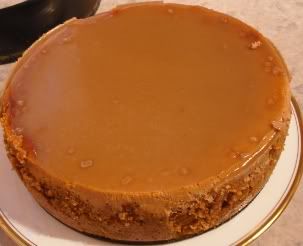
This is a smoked salt caramel cheesecake. I used the Australian Women's Weekly 100 Fabulous Cheesecakes book (first published 1971 - a very good example of changing fashion in food!), basing my recipe on their Luscious Gourmet Cheesecake recipe. I substituted dulce de leche and black treacle for the sugar and lemon juice, and added a scant half teaspoon of oak-smoked salt. I made a topping based on the one for the Caramel Topped Cheesecake, although I used dulce de leche and cream instead of butter, brown sugar and water.

It was divine. So divine that it is an appropriate way to celebrate Louise's blogoversary, and America's National Caramel Month. Louise is having a cookbook party to celebrate 4 years of blogging and I am sure a smoked salt caramel cheesecake will be welcome!


Tuesday, 11 October 2011

Fritto misto - fried chicken and courgette


I had chicken thigh fillets and a couple of fat zucchini and not a lot of anything else in the house. I cut them into chunks, marinated them in a little olive oil, lemon juice and paprika, then dunked them a few at a time in a very light batter. I deep fried them in batches in hot oil, drained them well and then sprinkled them with a little salt and a gremolata to finish.

We sat with the big, shared bowl in front of us, individual pots of sweet chilli sauce to dip the pieces in, bite by bite. The chicken and zucchini were both juicy and tender inside, crisp and crunchy outside. We watched The Big Lebowski. It was a very good match.

Thursday, 6 October 2011

A tale of two curries

I have made a couple of really stonkingly good curry meals recently. I mean really, seriously good curries. I have been astonished at my own cleverness.
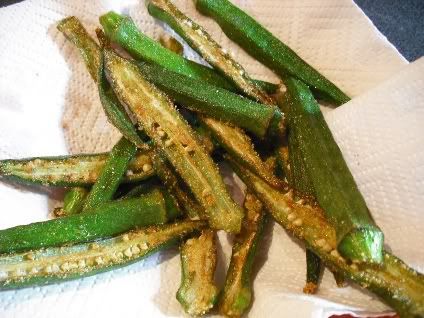
The big thing about these curries - which slightly takes the wind out of my sails - is that the side dishes, made from other people's recipes, were what totally made the meals.

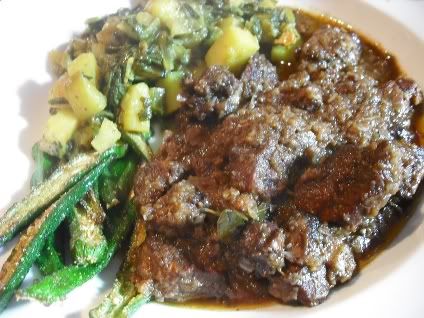
My pork vindaloo, adapted from Camellia Panjabi's recipe, is always good. The saag aloo was made particularly memorable by
fragrant, fresh turmeric. The dish of the meal, however, were the bhindi bhaji from Mamta's kitchen. They were crisp, flavourful and absolutely delicious. Which is not something you can always say about okra!

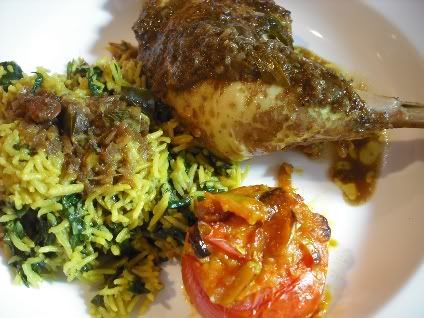
A couple of weeks later I made a chicken curry, again from an adapted Camellia Panjabi recipe (I used coconut water instead of coconut milk for the gravy). It was excellent, but again the star dish was one of the sides - Nigel Slater's baked, spiced tomatoes. The unusual thing about these tomatoes was that I used a touch of mustard oil instead of mustard seeds, and it ended up with a very intense dairy flavour - like they'd been stuffed with roquefort almost. Very interesting and extremely delicious.


Monday, 3 October 2011

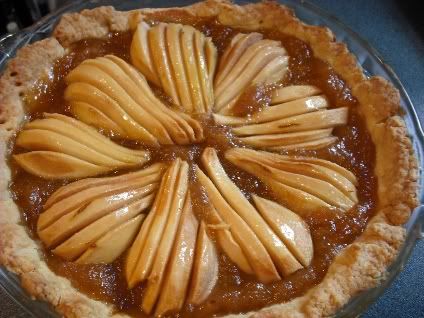
Spiced pear and apple tart

I wish I could give you a proper recipe for this, because it was really very good, but I can't. You see, I went into the kitchen with an idea in my head and just sort of riffed until it came together.

This is not my usual approach. Normally I would google, find 6 approximate recipes for what I wanted to achieve, consult another 3 cookbooks and see what they had to say on the matter, then put together all the bits I liked. I found it remarkably freeing not to go through that process!

I made a sweet shortcrust pastry, from a bit more flour than butter, with some sugar and an egg.

While the pastry rested, I made a spiced apple puree from 5 very small apples, a slosh of hard cider, a spoonful of sugar and a goodly pinch of cinnamon, nutmeg and cloves. When the apples were soft I squashed them with a fork to a rough puree.

I blind-baked the pastry case while the apple puree cooled. I felt that this was the best approach to getting crisp pastry.

Then I spread the puree in the case and topped it with halved pears, raw and pretty hard, cut into slices for prettiness and ease of serving later. I brushed the pear halves with a little calamondin marmalade.

I baked it for about 40 minutes until the pears were burnished and the pastry was an appetising golden brown and the kitchen smelled like autumn.


Friday, 30 September 2011

Simon Says: British Food Fortnight

It's the 10th annual British Food Fortnight (17th September to 2nd October - I am late to the bandwagon). I had a look down the list of 14 ways to participate, and to be honest none of them really floated my boat. It's either things I already do (seek local food, buy British, choose seasonal produce, cook British dishes, explore regional food) or really have no connection to (children's menus, school dinners, going to church for harvest festival).

We did celebrate the Harvest/autumnal equinox in time-honoured fashion with a couple of cans of cider, though.

The thing about British food, like British people really, is that it is a bit of a mongrel. Waves of invasion and immigration and colonisation have added dishes, techniques and ingredients to the menu that were never native to the UK. And this is a Good Thing, since otherwise we'd just be eating onions and broad beans. Even the rabbit was introduced. What really makes British food British is the fact that people are cooking British ingredients in Britain. It's the terroir, don't you know.

Quiche Lorraine. If you call it kweech it makes it British.

So I decided that to really commemorate British Food Fortnight I was going to draw your attention to a very British national treasure of the food scene: Simon Hopkinson. Now, if you aren't into food (why are you reading this blog?!) or you aren't from these parts, you probably haven't heard of this guy. But he gets name-checked by Delia Smith, Rowley Leigh, Hugh Fearnley Whittingstall, Nigel Slater - pretty much anybody in England who likes proper, unpretentious food with no shortage of flavour. In 2005 a book of his from the 1980s was voted "most useful cookbook of all time" by a panel of chefs, restaurateurs and food writers. This year, he made his first TV series, The Good Cook.


You can tell it was a good series from Paul's response. He is not the devotee of food shows that I am, so to grab his attention it has to be a bit special. He kept declaring that every university student in the land should watch this series, that there was no excuse to eat rubbish when Hopkinson was showing so very clearly how to cook delicious, simple things from scratch. He gets quite emotional at the thought of young people living off chicken nuggets and Iceland ready meals. He also kept demanding that I add the dishes to our menu, and no one can say I am not an obedient woman. Well they could really, but on this I agreed with my lord & master and let him think it was his idea.
Fried ham and cheese sandwich - like their namesake the 4th Earl of Sandwich, English to the core! And not at all a croque monsieur.

Apparently I am deficient in my wifely duties, having never made a lemon drizzle cake before. This isn't from the Good Cook series, but it is a Hopkinson recipe. And quite sublime too.

The Hopkinson recipe was for a rhubarb crumble, but I had apples. It was very nice, but I really do prefer my normal crumble with oats and nuts and whatnot added.

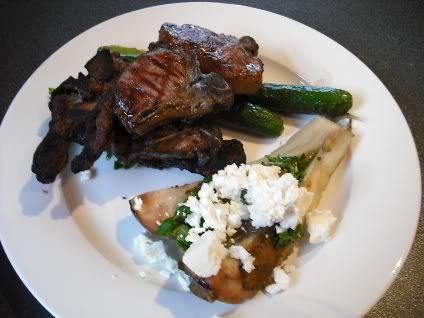
Grilled aubergines with olive oil, garlic, parsley and feta cheese. No doubt stolen from the Greeks at the same time as the Elgin marbles and they are not getting this back either.

As Jay Rayner wrote recently, "if you really want to do justice to the British larder, you'd better be sodden with French technique". Excellent produce, cooked with a bit of care and centuries of knowledge picked up from all over. That's really what British food is about.

Monday, 26 September 2011

Meat-Free Monday: Carrot & Feta Cake


Some people seem to have been a bit shocked by the news that arch-carnivore Hugh Fearnley Whittingstall, whose Meat book is the last word on the subject, has published a book of meat-free recipes. I don't know why there should be such a kerfuffle. It seems obvious that for sustainable living and good health, eating less meat is a good idea. And it isn't as though he has ever rejected vegetables. From the earliest River Cottage TV shows, he has always given as much time and consideration to growing and preparing vegetables as he has to rearing & butchering & preparing meat.
I don't think this is a recipe from his new book, but it is a delicious meat-free savoury cake. Delicious in a big chunk eaten instead of a biscuit with morning tea, better alongside a bowl of vegetable soup. If you have a hard time dealing with the idea of a savoury cake, call it a loaf and no one will bat an eyelid.

LinkWithin

Related Posts Plugin for WordPress, Blogger...