Showing posts with label waste not want not. Show all posts

Thursday, 2 June 2016

A barbecue or two


It turns out that this week's festival-for-raising-awareness-of-things-we-already-knew-about is National Barbecue Week. It's the 20th anniversary of it, in fact.

Apparently the average British family now barbecues nine times a summer. Since we barbecue about three times a week from April to October, that doesn't leave a lot of barbecuing for anyone else, but there you go. Of course, most of our barbecues are simple, after work affairs, grilling some sausages or some veg and minimising the amount of washing up that will need to be done. But on a weekend if the weather forecast is OK, we'll plan something that takes a bit more effort and is a bit more extravagant.
Brisket point
Project Brisket was such a success, and we still had the point half in the freezer, so we decided to have another go. With the added complication that we weren't going to eat it at our house. So we rubbed and we smoked, then wrapped it tightly in foil and towels and took it over to friends, where it finished cooking in their barbecue.

It wasn't as successful as the first one. I think we didn't give it long enough in the second half of the cook. It was delicious, but not as meltingly tender. You actually needed a butter knife to cut it. Paul was disappointed in himself.
Good bark, nice smoke ring
But honestly, if you hadn't tried the previous attempt you wouldn't have felt there was anything lacking.

We took a good portion of leftovers home, which made a fantastic salad (cold salad vegetables, warmed-through meat, tangy Thai-ish chilli and fish sauce dressing), with some sweet potato wedges.

Having scratched his brisket itch, Paul decided that ribs were to be the next target. According to Neil Rankin's excellent book Low and Slow: How to Cook Meat, American pork ribs have a lot more meat left on them, whereas pork belly is so profitable for butchers here that they trim really close to the bone. He does talk about the conversation you need to have with your butcher to get really meaty ribs, but that wasn't something I felt up for, so I just bought a couple of scrawny racks from the supermarket.
We rubbed them with salt, pepper, garlic powder and paprika and smoked the living daylights out of them in a cool, humid barbecue, then poured on a tamarind glaze, wrapped them in foil and finished the cooking. Then, while they rested, I deep fried some okra and made a salad. The ribs were perfection. Just meaty enough, with excellent flavour, and tender enough to slip easily off the bones.
Jalapeno & cheddar cornbread to go with pulled pork
Having conquered brisket and ribs, Paul decided that pork butt was his next ambition. I removed the rind (it was going to cook too long, slow and humid for crackling) and put it in the freezer for some day in the future when I fancy making chicharrón. I scored the fat and rubbed the whole thing with a mixture of salt, pepper, fennel seeds and garlic powder (5g each salt, fennel and garlic, 10g peppercorns - made more rub than I needed).

Then the usual routine of long, slow smoking (apple wood, this time), then wrapping for the rest of the cooking time.

I couldn't be bothered making a sauce for it, so after we broke it up into chunks we just sprinkled it with a little Tabasco. We had it with cornbread, and an olive and orange salad. Some of the leftovers went into a sort of Chinese chilli sauce with aubergine and made a very satisfying meal the following day. I think we've held our end up for British barbecue.

Sunday, 1 May 2016

Project Brisket

Paul's had a bee in his bonnet lately. For over a month now, any time you walk into our study you will find him glued to youtube watching (mostly) big, (mostly) white, (mostly) men talking about pecan, mesquite, Kansas-style, Texas-style, Carolina-style. He's become obsessed with American barbecue. Specifically barbecued brisket.

We've barbecued a brisket years ago, not at all successfully. With our little Weber we weren't able to control the temperature and it ran too hot, too fast leaving dry, tough meat. Then we tried a hybrid approach, smoking the meat in the barbecue for flavour and finishing with a long slow cook in the oven. That worked very well, but it's been two years and we haven't repeated it.

But I think you've probably noticed that Paul takes his role as Chief Wielder of Fire and Knives quite seriously, and his ability to cook anything on a fire is one of the cornerstones of his identity. Without my even noticing, the brisket had become his white whale.

We ordered a whole packer cut brisket and he took a day off work (although the day off work was mostly planned because of the late finish of the Captain America marathon).
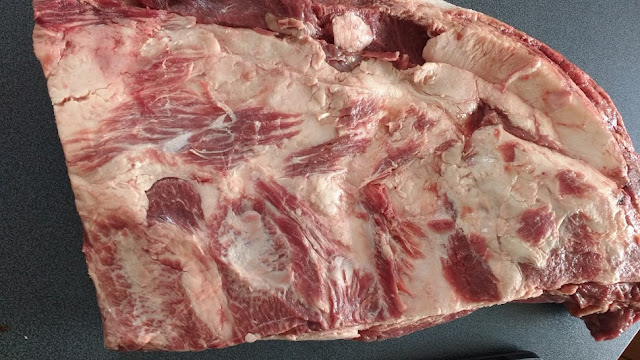
Whole brisket
Brisket point
Brisket flat
Now, a 6kg brisket is actually too big for the hot air to circulate properly in our Weber, and vastly too much food for two people, so Paul trimmed it and cut it in half. As delicious as beef dripping chips are, we're trying not to eat very much of that sort of thing at the moment, so most of the lovely clean white fat is going to go out for the birds. The brisket point is in the freezer and we just cooked the flat.

Since Paul was so invested in his research, I figured I should probably be a useful and supportive partner and do a bit myself. Which consisted of opening Hog and reading the page on live-fire cooking. That gave the inspiration for moderating the heat with pans of water for the indirect cooking. Paul's been worshipping at the altar of Aaron Franklin, where he got the tip that keeping the humidity up is important, and the pans of water helped with that too.
Indirect cooking set-up
A pan of water under the meat, and more directly over the coals (we didn't have a smaller foil pan, so an empty artichoke heart can got washed out and put into service).

A good bit of seasoning rubbed on the meat (although as it turned out, not enough and not massaged in enough)  and away we went.

We'd realised that a really important part of moderating your temperature to keep it low and slow is to actually know what the temperature is. So a thermometer went in as well. And despite all the talk about hickory, pecan and mesquite, we decided that excellent British meat cooked in Britain needed a typically British smoking wood, so we used cherry.

Of course, being a British barbecue we also had to deal with some challenging climatic conditions. Pretty much as soon as we got the lid on the heavens opened, with rain and hail. Still, it was better than Tuesday, when it snowed.  And one of the things that seldom gets mentioned when talking about barbecue is how much impact the ambient temperature has. We can and do barbecue in mid winter, but when it's really cold outside it'd hard to keep the temperature up for the fire to cook anything bigger than a steak. But when you want a long slow cook, a bit of colder air around the kettle isn't a bad thing, and helped us keep the fire between 120C - 150C for the duration of the cook.

After a few hours, when the internal temperature of the meat was 78C, just through the plateau, we wrapped it in foil and kept cooking for another couple of hours. Then it rested until we couldn't bear it any more.
Not bad
Pretty good really

It's actually a tribute to Paul's knife sharpening skills that he was able to cut it into tidy slices, because it was soft as jelly and could have been cut up with the side of a saucer.
Pretty pink smoke ring
We had it with spicy chipotle slaw, pickles, and a chunk of bread for mopping the plate. Absolutely gorgeous (but slightly underseasoned - more salt during the cooking next time).
leftovers
As tempting as it was to just nibble at the leftovers every time we walked by the fridge, I did something a bit more substantial with them. An old-school Stroganoff, with paprika, brandy, vermouth, lots of mushrooms and a little bit of crème fraiche.    

Brisket Stroganoff

Tuesday, 19 April 2016

Sour cherry, pistachio & coconut fridge cake


Paul was very generous with the Lindt bunnies this Easter. So generous that we actually got a bit tired of eating delicious, smooth milk chocolate by itself.

And I had a day of dance workshops requiring a portable high-energy snack, so I delved in the cupboard for things that would be nice with chocolate. I came up with lovely unsweetened dried sour cherries, sweetened coconut flakes and shelled pistachios. I thought about adding some crumbled shortbread as well (tiffin/fridge cake things usually have some biscuit mixed in) but the only ones we had were Walkers shortbread Scottie dogs, and while I have no qualms about biting the head off a biscuit, I thought maybe melting down bunnies was enough animal carnage for one recipe.

It's incredibly easy, and adaptable, but this really was a very good combination.

Sour cherry, pistachio and coconut fridge cake (makes about 12 pieces)

200g milk chocolate (2 bunnies worth)
50g dried sour cherries
50g coconut
50g pistachios

Gently melt your chocolate in a heatproof bowl over simmering water.

Line a loaf tin with baking parchment. Combine the cherries, coconut and pistachios and place in an even layer in the loaf tin.

When the chocolate is melted and smooth, pour it into the loaf tin and give everything a bit of a wiggle with a spatula to make sure the chocolate gets through to the bottom.

Set in the fridge for an hour or so.


Wednesday, 28 October 2015

Duckherd's Pie - duck and celeriac shepherds pie

Duck scratchings

I am pretty sure "duckherd" isn't a word. And I am reasonably certain the Goosegirls of Grimm's Fairy Tales don't exist as a profession any more - if they ever cared for ducks as well as geese. But if a shepherd looks after sheep and a shepherd's pie is made of lamb, I decided that a duck pie, topped with celeriac mash, had to be a duckherd's pie.

Skinned duck breasts
It has lovely autumnal flavours and all the comfort you want from a mash-topped pie, but a bit of luxury from the duck.

This is a fiddle, because you have to render the duck skin into scratchings and mince the duck breasts, but you can do it in advance to take away the memory of the pain and it ends up tasting delicious. And we have extra pies in the freezer for another day.

Duckherd's Pie (serves 4)

4 duck breasts
2 leeks
2 stalks of celery
2 carrots
1tsp green peppercorns in brine
2 bay leaves
sprig thyme
1/2 cup vermouth or white wine
salt
1 small celeriac
2 medium potatoes
2 cloves of garlic
butter

Skin the duck breasts. This is pretty easy - basically just grip the edge of the skin and pull it back, using a sharp knife to coax any membrane away, so you end up with a clean, lean piece of meat and a thick piece of skin with a nice fatty layer.

Slice the fat into 1-2cm wide strips, put in a small saucepan with some cold water and bring to a boil on a medium heat. This will look very unappealing for quite some time as the strips go grey and wrinkled. But then the fat will start to render out and the water will evaporate (it's just there to stop things from sticking while you get going) and eventually you will be left with a pot of clean duck fat and a treasure trove of crisp brown duck scratchings. Drain, reserving the fat. Tip the scratchings onto a paper towel-lined plate and don't eat all of them because you need some for the garnish.

Cut the duck breasts, leeks, celery and carrots into chunks your mincer can manage. I try to keep the pieces a bit separated so I can do the duck first, followed by the veg, because I think it makes the mincer easier to clean.
Ready for mincing
Run the duck, green peppercorns and veg through the mincer on a coarse blade. Some of the peppercorns will stay whole, some will be minced, but I like that. If you don't like the peppery shock of biting into a whole peppercorn, chop or crush the peppercorns first.
Minced and ready to cook
Add a couple of tablespoons of the rendered duck fat to a heavy bottomed sauté pan and brown the minced duck and vegetable mixture. Add bay leaves, thyme and vermouth or white wine, put the lid on and let it simmer for about an hour until thick and rich. The minced vegetables give off a lot of liquid so you shouldn't need extra, but if it is looking too dry add a bit of chicken stock or some more wine. Season with salt.

The remaining duck fat can go in a ramekin covered with cling film for a couple of weeks of good roast potatoes, or into the freezer for the Christmas spuds.

Divide the mixture between four ovenproof bowls, removing the bay leaves and woody thyme sprig if you come across them. Or make just one large one if you don't have to worry about portion control or there are more than two of you at dinner. I made two to eat that night and two in foil containers for later.

Peel and chop the celeriac and potatoes into even-sized chunks and boil until tender, giving the celeriac a 10 minute head start. Add the peeled garlic cloves in with the potatoes. Drain the veg and mash thoroughly with a good knob of butter.

Spread the mash over the duck ragu. I don't go in for piping that sort of thing but you could if you wanted to. I did try to pretty it up a little bit though. Allow another little nut of butter to melt over the surface of each one, and garnish with a couple of duck scratchings.

Allow the ones you are freezing to cool completely, cover and freeze. The ones you want to eat sooner rather than later will need a 180C oven for 35-40 minutes until the top is well-browned and the filling is bubbling up around the edges. Serve with a simple green vegetable.


Sunday, 24 May 2015

St Clements Brownies

Just like the T1000 melting at the end of Terminator 2.
I know some people laugh at the notion of "leftover chocolate", or even "chocolate you haven't eaten yet", but around Easter I realised I had some chocolate left from Christmas and wanted to use it up. It was dated best before October this year (better not to think about what they did to it to give it that shelf life), so I could have kept it for longer, but I felt that it was time.

I also had most of a packet of Marks & Spencer nuts which had sounded really tempting at the checkout but didn't really float my boat as a snack. They were very sticky and the pack wasn't re-sealable and it was all a bit messy. Plus after about a minute I found the random use of italics on the pack irritating.

The milk chocolate was too sweet for me, so I added 100g of very dark chocolate to it as it melted, poured it over the nuts and let it set. It made a fantastic, sustaining snack for a long day of dance workshops.

But then I still had quite a lot left over of that. And for a couple of weeks it sat in the cupboard, never quite tempting me. So, since it had been ages since I sent anything in for the gannets Paul works with, I turned it into brownies. This is fairly typical of the way I approach leftovers - I try really hard to avoid food waste and some things go through a couple of different incarnations on the way.

St Clements Brownies

125g butter
300g St Clements chocolate, chopped (or any dark fruit & nut chocolate, but without the orange and lemon bits it won't be St Clements)
3 eggs (I actually used 2 whole eggs and 1 yolk, because I wanted the white for something else)
100g caster sugar
200g plain flour

Preheat the oven to 180°C. Line your favourite brownie-baking tin with baking parchment.

In a double boiler, or heatproof bowl set over a pan of simmering water, melt the butter and chocolate. Remove from the heat and allow to cool slightly.

In a separate bowl, beat the eggs and sugar until pale and fluffy. Beat in the cooled chocolate mixture. Fold in the flour. Pour into the lined tin and bake for 20 minutes or until the top is firm and the inside is still a bit soft. Cool in the tin before cutting into squares.
Definitely delicious - I kept some back for myself

Thursday, 25 September 2014

Haggis & Apple Cottage Pie - an act of union

 I am very sorry for the disappointed Yes voters, who had good reasons for wanting independence, but at the same time sentimentally I am pleased that Scotland isn't leaving us. I wouldn't say that Scotland puts the great in Great Britain, exactly, but if you look at any list of British achievements, a fair whack of them are Scottish. Hypodermic needles, pneumatic tyres, thermos flasks, the telephone, the television, waterproof fabrics and penicillin, all invented, discovered or developed by Scots. And of course, the haggis (although that might be Roman...)

So, to celebrate the continued existence of the United Kingdom, I bought a haggis. I was intending to serve it with chips, peas and gravy, but then Rachel McCormack tweeted her recipe for a haggis, apple and potato tart, which I thought was brilliant. Hers was very elegant-looking - a flat puff pastry tart, filled with slices of potato and apple with crumbled haggis. Mine is not elegant, but it is tasty and a good entry point for people who are scared of haggis but still intrigued.

Whenever I make a recipe that needs a carrot/onion/celery base, rather than trying to find a single stick of celery, I make a large quantity, sweated down in a bit of oil, and then freeze it in portions for later. A thawed bag of that - on this occasion celery, leeks, onions and carrots - was my base. A couple of dessert apples, peeled, cored and finely chopped, and a haggis, broken into large chunks.

I made up some instant gravy paste, and flavoured it with some cider brandy, and made a strongly mustardy mash (hence the lurid yellow colour). As I dolloped the Colmans mustard into the pan of spuds, I realised that I had ingredients representing all the parts of the United Kingdom - leeks for Wales, potatoes for Northern Ireland, apples and hot English mustard for England and the haggis for Scotland. My sense of kitsch got the better of me, and instead of roughing the mash up with a fork, I traced a union jack onto the surface with the point of a knife. When it came out of the oven, I was delighted to see that it had held. There's a metaphor there.

LinkWithin

Related Posts Plugin for WordPress, Blogger...