Showing posts with label poultry. Show all posts

Wednesday, 27 April 2016

Diana Henry's chicken with sour cherries and parsnip puree


I wasn't intending to post anything for this week's I Heart Cooking Clubs potluck. Time got away from me and I didn't get around to cooking anything specially. But I woke up to the news on twitter that Diana Henry had won the James Beard Foundation award for Best Single Subject Cookbook for A Bird in the Hand. Which is such a fantastic achievement I thought I should have a rummage through my photos for one of Diana's dishes that I haven't already posted about!

And lo! I found this fabulous, elegant dish of chicken legs with pinot noir, sour cherries and parsnip purée that we enjoyed a few weeks ago. Normally chicken leg recipes are aimed at weeknight, workaday meals, but this lifted them into a special occasion meal.

Not that we had them for a special occasion, just as our Sunday roast. Which I suppose is a little celebration.

At Easter we'd bought another cockerel which I'd jointed and frozen, so I used the cockerel legs for this. They are huge, so I had to adjust the cooking time, but other than that I followed the recipe. The parsnip purée was creamy and luscious, with a sweetness that worked extremely well with the tartness of the sour cherry sauce. Divine, and definitely to be recommended. You can see why this book won a James Beard award.

Thursday, 18 February 2016

Plums

Plums
Way back at the end of summer, which seems like a million years ago, a friend left a bag of plums on the doorstep. I knew she was going to - her daughter's tree was laden and she'd made as much jam as she could be getting on with - but I didn't realise just how many there were. It wasn't quite like the cherry mountain, but it was a good 5kgs of small, ripe plums.

I've been meaning to post about those plums and what I did with them for ages, but I kept thinking "just one more dish and then...".

I made jam, of course. But I think I overcooked it and I haven't actually been game to try and get it out of the jar yet. Might need a hatchet.
Baked plums with almonds
I baked some, with a handful of almonds for crunch, and ate them with vanilla yoghurt for breakfast. I stewed some and froze them in portions.
Custard slice
I baked some in a sort of galaktoboureko-inspired custard slice. It would have been much more successful if the phyllo pastry I ordered had turned up - as it was I used puff, which was too thick and didn't bake through nicely. Tasted good but.
Custard slice, sliced
Some went into a rather nice duck dish, with ginger and star anise. I should have written down the recipe.
Duck in plum sauce
But most of them I semi-dried and then bottled in a boozy syrup. I dipped each half in a simple syrup, laid them on a rack over a baking tin, and cooked them in a 120C oven for about half an hour until they were slightly dried and chewy. They went into a sterilised jar, and I poured equal measures of hot simple syrup and rum over them.

The jar has sat in the kitchen for months, waiting for inspiration to strike.

Finally I decided. I baked them in a tart with a pistachio frangipane. And very nice it was too.


Saturday, 23 January 2016

Three ways with cockerel


Last Easter we bought a cockerel for the first time - we had it roasted and did a couple of things with the leftovers and it was delicious. Unfortunately they only seem to be available at Christmas and Easter, so we had a long wait for another.

We had other plans for our big Christmas meal, and a 4kg chook isn't really the most practical thing for a family of two, so I split it into a crown, leg and thigh joints and wings, freezing the pieces separately, along with a bag containing the giblets, back and wingtips, which will eventually become stock.

The first meal we had from it was Simon Hopkinson's recipe for coq au vin. Which was, of course, as a Simon Hopkinson recipe much more involved than you would think a chicken stew needs to be, but the fiddle pays off. It was definitely the nicest coq au vin I've ever made.

A couple of days after that, we had the crown, simply roasted. It was big enough that we only ate one of the breasts (with pigs in blankets, because one of Paul's colleagues was pitying him that he hadn't had any over the Christmas period).

The leftover coq au vin and roast breast meat became a pretty amazing chicken pie, with a bit of proscuitto added for extra oomph.

I kept aside some of the coq au vin gravy to make a dish Hopkinson recommends, of poached eggs in the gravy. Which was nice but not that special and extremely unphotogenic. So let's just finish with a slice of pie.

Monday, 28 December 2015

Christmas feasting


For our Christmas dinner this year we bought a plump Yorkshire duck from Turner & George. We tossed around a few ideas but decided to look to the East for our meal - following Meera Sodha's recipe for roast duck fesenjan.

Initially I'd thought to just do the wonderful persimmon & chicory salad we had last year, but for some reason Ocado aren't selling persimmons this year, and the thought of going to an actual shop was just not to be born. So I made a different Diana Henry recipe, a bulgar pilau with glazed figs from A Change of Appetite. I thought the balsamic and honey glazed figs would play particularly nicely with the sweet/sour pomegranate in the duck. And they did. Instead of the cavolo nero in the original recipe, I added a packet of flower sprouts on top of the bulgar wheat, to steam gently while the wheat cooked. It made a dish that was both delicious (lovely nutty bulgar, delicious tender flower sprouts, juicy figs) and festive.

For dessert I'd made some citrussy trifles. I did individual portions because it was just us and a big trifle looks so messy and unappetising once a couple of spoonfuls have come out, so the spares could stay pristine in the fridge for a couple of days. They were mini orange and lemon sponges (half iced, which is why there is a big white smear half way down), with a good slosh of Cointreau, then orange suprême and Cointreau and orange jelly (just freshly squeezed orange juice and a bit of Cointreau, set with leaf gelatine), then a layer of (bought) vanilla custard, topped with orange syllabub and garnished with crystallised pomelo rind. Very boozy, but fresh and lovely.

Of course, a whole duck is still a bit much for two, so on Christmas Day we just had the breasts. On Boxing Day I pulled the rest of the meat from the bones and reheated it in the remaining walnut sauce. I made some spinach rice and a simple apple raita. And it was just as delicious as the original roast.


Saturday, 19 December 2015

Other bloggers' dishes

It's less than a week to Christmas and it's hard to believe we're so close to the end of the year. I thought about doing a gift guide but I've clearly left it too late - so if you are still at a loss, have a look at Kavey's or Gemma's for inspiration. I thought about some other sort of seasonal round up - favourite things I've cooked this year or something - but that just hasn't grabbed me either. Instead, here is my latest round up of Other Bloggers' Dishes: the things I have cooked from other blogs.

Helen Graves' Nargisi kofta curry was basically spiced lamb scotch eggs in a yoghurt-based gravy. Completely delicious and very, very filling. Really - you may think you could eat two kofte but I would be surprised.  

Given that Ed's been writing for The Guardian and who knows who else lately, it seems a little cheeky to claim his tarragon chicken for this series, but there you go. Delicious and old-school. I added some mushrooms, because mushrooms love tarragon so much, and served it with basmati rice to soak up the sauce and some kitsch little bean bundles (not, I assure you, prepared by me).

Heather's mashed butternut and potatoes with roasted garlic, smoked gouda and bacon looked so appetising and indulgent, like a perfect holiday side dish if your family isn't utterly wedded to roast potatoes. Unfortunately, when I came to make it my squash (kabocha, not butternut) had gone a bit tragic, so it was just potatoes. And I used my ricer on them, not a hand mixer. They were fab though. Definitely worth doing again - with the squash next time.
Squashless mashed squash
And finally, Miss South's Easy Salted Caramels. These would be a perfect gift for any friend who is known to eat condensed milk by the spoonful. When I saw them on her blog I immediately imagined them rolled in freeze-dried raspberry or cranberry powder, for a bit of a tang. Which is what I did. Unfortunately, the cranberry powder is so intense that, unadulterated, it tastes like cystitis powder. SO I tipped the caramels back into a bowl, microwaved them for 30 seconds to make them pliable and kneaded them back together, giving me a pleasantly cranberry-flavoured pink caramel. I rolled it into balls again per Miss South's instructions, then rolled them in more cranberry powder, this time diluted with sifted icing sugar and some food-safe glitter. Sparkly and very delicious!

Saturday, 5 December 2015

Piquet, Fitzrovia

Beetroot & goats cheese
For a few weeks I'd been hearing increasing buzz about Piquet. Well, maybe not buzz. More of a well-mannered murmur of appreciation and licking of well-fed lips. People whose opinions on food I respect were saying it was very nice. And grown-up. You could book a table and drink out of actual glasses. Then I also saw a suggestion that it was going to be reviewed by the big guns, so decided I needed to go while it was still possible to get in.

We chose the "Discover Piquet" menu option, at £29.95 for three courses and a welcoming drink. I started with a heritage beetroot salad, goat’s cheese mousse, black figs and hazelnuts - comfortable in the knowledge that Jude can't bear goat's cheese, so I wouldn't have to share. Beetroot and goat's cheese is such a safe combination, but this was beautifully composed, with the leaves, figs and toasted hazelnuts adding extra dimension. The slices of golden beetroot confused me, because even though I knew it was beetroot my eyes kept telling me it was persimmon and my palate didn't know what to think.

Jude had celeriac velouté, trompette mushrooms, of which I didn't get anything approaching an acceptable photo. The presentation elevated the soup, poured from a jug around the black mushrooms, but the flavour lived up to the theatre.

I had chicken with a wild mushroom raviolo and salsify as my main course. The portion was a touch on the dainty side but it was the most wonderfully chicken-flavoured chicken I've had in ages. The salsify was lovely - it's such a pain in the arse to prepare that I am always happier to have someone else do it. Unfortunately the raviolo was a bit underdone and firm to the bite.

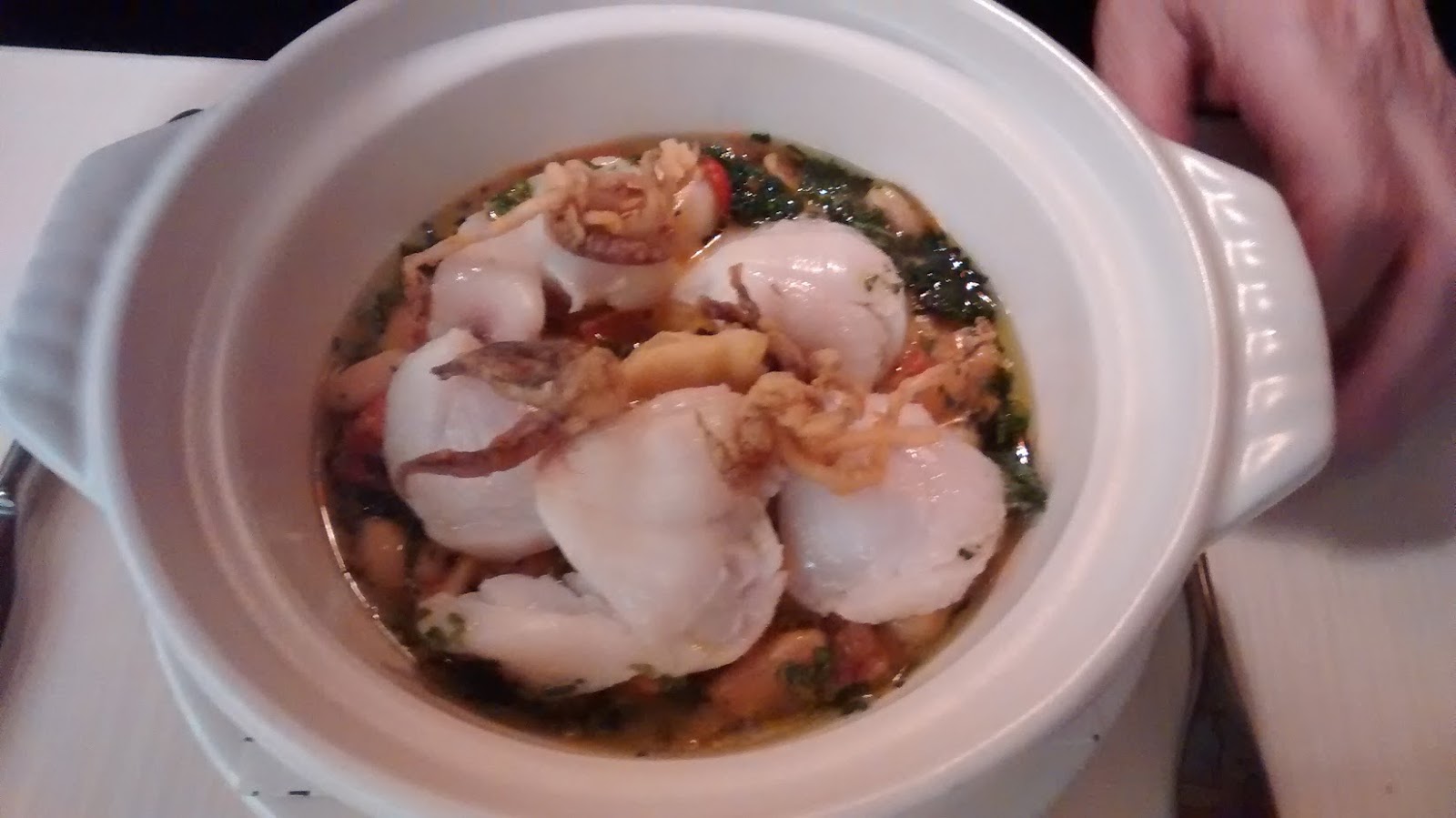
Jude definitely won the main course round. Her casserole of cod cheeks, baby squid & chorizo, haricot blanc and chopped herb oil was a more generously sized portion, the little squidlets on top were perfectly crisp and the cod cheeks sweet and delicate.

We'd both ordered gin and tonics when we arrived, so one of the (well trained, very lovely) waiters offered us glasses of cava instead of the house cocktail included in the menu.  And very nice it was too. So good, we had seconds with our desserts.

Jude finds it very difficult to go past iles flottante on a dessert menu. So she didn't even try. It wasn't as pretty as the one they do at Brasserie Zedel (they use those bright pink sugared almonds as the garnish), but it was good.

My baked almond tart was utterly gorgeous. Thin, crisp pastry, a thin layer of something like powidl, then a lovely frangipane filling and some not-too sweet prunes. It was served warm with whipped cream on the side. Classic and wonderful. Just like the rest of Piquet.


Wednesday, 28 October 2015

Duckherd's Pie - duck and celeriac shepherds pie

Duck scratchings

I am pretty sure "duckherd" isn't a word. And I am reasonably certain the Goosegirls of Grimm's Fairy Tales don't exist as a profession any more - if they ever cared for ducks as well as geese. But if a shepherd looks after sheep and a shepherd's pie is made of lamb, I decided that a duck pie, topped with celeriac mash, had to be a duckherd's pie.

Skinned duck breasts
It has lovely autumnal flavours and all the comfort you want from a mash-topped pie, but a bit of luxury from the duck.

This is a fiddle, because you have to render the duck skin into scratchings and mince the duck breasts, but you can do it in advance to take away the memory of the pain and it ends up tasting delicious. And we have extra pies in the freezer for another day.

Duckherd's Pie (serves 4)

4 duck breasts
2 leeks
2 stalks of celery
2 carrots
1tsp green peppercorns in brine
2 bay leaves
sprig thyme
1/2 cup vermouth or white wine
salt
1 small celeriac
2 medium potatoes
2 cloves of garlic
butter

Skin the duck breasts. This is pretty easy - basically just grip the edge of the skin and pull it back, using a sharp knife to coax any membrane away, so you end up with a clean, lean piece of meat and a thick piece of skin with a nice fatty layer.

Slice the fat into 1-2cm wide strips, put in a small saucepan with some cold water and bring to a boil on a medium heat. This will look very unappealing for quite some time as the strips go grey and wrinkled. But then the fat will start to render out and the water will evaporate (it's just there to stop things from sticking while you get going) and eventually you will be left with a pot of clean duck fat and a treasure trove of crisp brown duck scratchings. Drain, reserving the fat. Tip the scratchings onto a paper towel-lined plate and don't eat all of them because you need some for the garnish.

Cut the duck breasts, leeks, celery and carrots into chunks your mincer can manage. I try to keep the pieces a bit separated so I can do the duck first, followed by the veg, because I think it makes the mincer easier to clean.
Ready for mincing
Run the duck, green peppercorns and veg through the mincer on a coarse blade. Some of the peppercorns will stay whole, some will be minced, but I like that. If you don't like the peppery shock of biting into a whole peppercorn, chop or crush the peppercorns first.
Minced and ready to cook
Add a couple of tablespoons of the rendered duck fat to a heavy bottomed sauté pan and brown the minced duck and vegetable mixture. Add bay leaves, thyme and vermouth or white wine, put the lid on and let it simmer for about an hour until thick and rich. The minced vegetables give off a lot of liquid so you shouldn't need extra, but if it is looking too dry add a bit of chicken stock or some more wine. Season with salt.

The remaining duck fat can go in a ramekin covered with cling film for a couple of weeks of good roast potatoes, or into the freezer for the Christmas spuds.

Divide the mixture between four ovenproof bowls, removing the bay leaves and woody thyme sprig if you come across them. Or make just one large one if you don't have to worry about portion control or there are more than two of you at dinner. I made two to eat that night and two in foil containers for later.

Peel and chop the celeriac and potatoes into even-sized chunks and boil until tender, giving the celeriac a 10 minute head start. Add the peeled garlic cloves in with the potatoes. Drain the veg and mash thoroughly with a good knob of butter.

Spread the mash over the duck ragu. I don't go in for piping that sort of thing but you could if you wanted to. I did try to pretty it up a little bit though. Allow another little nut of butter to melt over the surface of each one, and garnish with a couple of duck scratchings.

Allow the ones you are freezing to cool completely, cover and freeze. The ones you want to eat sooner rather than later will need a 180C oven for 35-40 minutes until the top is well-browned and the filling is bubbling up around the edges. Serve with a simple green vegetable.


Monday, 21 September 2015

Yes, Chef! Doro wat and injera

I first heard of Marcus Samuelsson from Joanne's blog - she was publishing some of her recipes on his blog. And shamefully I didn't pay very much attention. They were her usual healthy but delicious-sounding vegetarian dishes but I never looked into who this Marcus Samuelsson was. If I had a mental image of him I guess I imagined he was a vegetarian chef from Minnesota or something. Then I saw an episode of The Taste and realised that he was definitely not a vegetarian from Minnesota.

It meant that I was delighted when his memoir, Yes, Chef!, was chosen as the latest Cook the Books Club selection. And the story of how an Ethiopian child was raised in Sweden and became a celebrity chef in New York is really quite something. In a Sliding Doors scenario there are so many little twists that could have changed everything - if his mother hadn't made it to Addis Ababa, if his grandmother hadn't taught him to cook - so many factors came into play, but Samuelsson's determination is the thing that shines through.

Having read Helen Graves' posts about visiting Ethiopia with World Vision, and the process of making injera, I was pretty keen to have that as part of my Cook the Books contribution. I discovered that Ocado sell teff flour in tiny quantities, but it was enough for me to have a go.

I followed this method, using 23g of teff flour and 60 ml water for a half quantity, every time it specified 1/3 and 1/2 cups. I did a seven day ferment, and it behaved perfectly. It bubbled when the recipe said it would bubble and had a fermented, grassy aroma when it was supposed to. I didn't do the bit with the food processor, because the flour was very finely milled and there wasn't any grainyness to get rid of.

The final addition of the self-raising flour was fascinating. This was my mixture when I added it - sitting just below the 400ml mark.

And this was the mixture a couple of hours later when I was ready to cook them. I guess the acid from the sourdough activated the raising agents in the flour and made it go nuts. Very satisfying.

I wanted to do something that would acknowledge both Samuelsson's Ethiopian and Swedish heritages, and I thought that little injera would be an outstanding base for very Scandi sour cream and cured fish. So leaving the batter a bit thick, I made canapé-sized bites.
They look like little crumpets
I meant to top them with crème fraiche, gravadlax and salmon roe, but laziness got the better of me and I couldn't be bothered making the gravadlax. I just went more lavishly with the salmon roe.

As a little snack these were perfect. The tang from the injera was the perfect thing with the salty salmon and creamy, sour crème fraiche. I might have to do these again, maybe for Christmas.

The main event, though, was the injera served with Samuelsson's own recipe for Doro Wat and a mustardy lentil salad. The lentil salad was not at all to my taste, but the firey Doro Wat was delicious.

I actually made this right at the beginning of August, but hadn't got around to posting. So now you only have about a week left if you want to join in! But it is definitely worth a read.

Saturday, 11 July 2015

Coronation Chicken Salad for Mystery Box Madness

I tried, OK? I really did. I approached this week's Mystery Box Madness challenge at I Heart Cooking Clubs with a completely open mind. And I still ended up doing a Diana Henry recipe.

For Mystery Box Madness we're allocated a list of ten ingredients, and we need to find a recipe from one of the featured chefs containing at least three of them. This week's ingredients were chicken, seaweed, sesame seeds, parsley, mozzarella, pasta, mango, brown sugar, zucchini and mint. I was absolutely sure I'd find a Nigella or Ottolenghi recipe using pasta, zucchini and mint. Or a Jamie Oliver recipe using mango, brown sugar and mint. But the first recipe that caught my eye was Diana Henry's take on Coronation Chicken.

Coronation chicken is the sort of post-War British cooking that gets a pretty bad reputation - invented by Constance Spry and Rosemary Hume for the coronation of Elizabeth II, it can be an extremely lurid combination of cold chicken, mayonnaise, curry powder and raisins. It's the dish that Americans should point to every time we say rude things about American food. But it can be absolutely wonderful. Made carefully, with a kick to the dressing and a good balance of fresh ingredients it's a really wonderful combination of savoury, sweet, creamy and crunchy. Diana's recipe uses fresh mint, mango and chicken breast - I used thigh fillets - and the mint gives everything a wonderful lift.

Tuesday, 19 May 2015

Diana Henry's A Bird in the Hand

Chicken with leeks, apples & cider (p 192)
A couple of months ago I posted about Diana Henry's chicken with leeks, apples and cider, the first dish I'd made from her new book, A Bird in the Hand. Well, since I bought the book, we've been eating a lot of chicken. A LOT of chicken. I'm not done with it yet, but I had to draw a line in the sand somewhere, so I thought I'd run through the recipes we've tried so far. I haven't been particularly methodical - I just cooked things I felt like eating rather than strategically providing a broad view. It's worked out pretty balanced, I think, although the recipes I've cooked have veered more towards Asian flavours. I think that is a seasonal thing - I tend to cook more European dishes in winter, so I have lots of things bookmarked that probably won't happen until October.

It's been produced by Diana's usual team, so the design and photographs are typically beautiful. The only real qualm I have with the book is the index, which I only found useful if I remembered the exact name of the dish I wanted to cook. For something like this where chicken is in everything, having dishes indexed by major secondary ingredients or cooking methods would have worked better, I think. I found myself using Eat Your Books a lot for this, once it was indexed.
Turkish-spiced chicken in a wrap with Greek yoghurt
Turkish-spiced chicken with hot green relish (p 32) was one of the dishes served at Diana's book launch party. It's incredibly delicious. Not super hot, but spicy and spiky with salty, herbal, acidic flavours. We don't have a griddle so I cooked the chicken in a cast iron frying pan - it didn't need extra oil for cooking because of the oil in the marinade.
Thai chicken burgers with Asian slaw
I couldn't get minced chicken for the Thai chicken burgers with Asian slaw (p 20), so I put chicken thigh fillets, the lemon grass, onion, ginger, lime zest and coriander through the mincer, then added the breadcrumbs and other seasonings. As you can see from the disconcerting purple speckles on the burger, I used a red onion. They were succulent, with a pleasant lightness from the breadcrumbs and had a very good flavour. The Asian slaw was excellent - just the thing if you find a mayonnaisey slaw cloying.
Royal chicken korma with chapattis and tomato katchumber
The book is divided into sensible (the starter/main/dessert structure doesn't really work with chicken!) but overlapping chapters - every day dishes, comforting dishes, salads, feasting dishes for when you have more time and so on. The Royal chicken korma (p 146) could easily fit into The Spice Route: scented, perfumed, hot chapter, but really it is in the right place in Feast: let's celebrate. It is a fiddle. I have a well-stocked spice cupboard, so I only needed to buy the perishables but even so when I looked down the lengthy ingredients list and read the method my heart sank. But take courage! This is probably the best curry I have ever, ever made. Disgorging and deep frying the onions for the spice paste gives an extraordinary depth of flavour. It is not a dish for every day but it is sublime. And I say that as someone who would never order a korma in a restaurant because I find them bland, sweet and dull.
Vietnamese lemon grass and chilli chicken - served with sauteed cabbage
Infinitely quicker and simpler, but still utterly delicious, was the Vietnamese lemon grass and chilli chicken (p 22). The red chillis I have been getting recently have no heat at all, so I used two without de-seeding and still needed to add a slosh of hot chilli sauce to give it a boost.
Roopa's lemon grass and turmeric chicken
Roopa's lemon grass and turmeric chicken with potato salad and date and tamarind chutney (p 50) is in The Spice Route chapter, but could so easily have fit into Feast. Not that it's particularly involved or that time consuming, but the potato salad accompaniment makes it taste extremely special. I used ground turmeric instead of fresh so my spice paste wasn't very pasty, but it still stuck nicely to the chicken. The potato salad with the chutney ends up tasting a bit like an aloo channa chaat, which is a very good thing for a potato salad to taste like.
Rice cooked in the fragrant chicken juices
The lemon grass and turmeric chicken also produced vast quantities of juices, far too much to serve with the chicken. So I saved it and cooked some basmati rice in it to have with a mutton methi curry later that week. It was so luscious I would do the chicken again just to make some more rice.
Balinese chicken, bean and coconut salad
This Balinese chicken, bean and coconut salad (p 112) was another one from the book launch party. Deliciously fresh and zingy, with a creamy underpinning from the coconut, it's lovely fresh and even though the herbs wilt a bit and lose some crunch, it's very tasty as leftovers.
Soothing North Indian chicken
So far, there has only been one dish that has really disappointed. The soothing North Indian chicken (p 185) just didn't work for me at all - very bland, and the yoghurt split even without boiling the sauce after adding it. The following day I turned the leftovers into a sort of biryani, stirring it through rice seasoned with cinnamon, cardamom, cloves and turmeric, which was much more to my taste.
Negima yakitori cooking
I've made negima yakitori before, so I was very interested in Diana's version (p 172). Mine were not the dainty morsels of her method, because I wanted to use my big, flat, metal skewers, but the flavour was excellent. I particularly appreciated the instruction to start grilling the seasoned chicken before basting with the sauce - so many recipe writers don't seem to understand how quickly things burn if they are marinated in a sugary sauce before cooking. The skewered spring onions add a lot of moisture and flavour to the chicken, and the little sprinkle of shichimi togarashi at the end adds a nice spicy kick.
They were very small aubergines - which we also basted with some of the yakitori tare
For Easter we decided to do something really extravagant and indulgent. Not just the indulgence of Roast chicken with truffles (p 150): we made it with a 3.95kg cockerel.
Steam rising from Roast cockerel with truffles
Obviously we ignored the cooking times for the massive beast, following the instructions on the box instead. We also ignored the serving suggestion of sauteed potatoes and watercress, going instead for Sunday lunch accompaniments of roast potatoes and sweet potatoes, and some peas. The buttery truffle sauce meant that no butter was needed on the peas. This was lovely, definitely worth getting a slow-grown chicken for, and we still have half a jar of black truffle slices left, so we're considering doing it again at Christmas (which is probably the next time fresh cockerel will be available).
Extravagant Sunday roast
Clearly an almost-4kg bird left us with a good supply of leftovers. Which amongst other things got turned into Vietnamese chicken and sweet potato curry (p 204), a super quick, fragrant and delicious use for leftover cooked chicken. And I think it would be very good with leftover pork too. Because of the sweet potato in it we decided we didn't need any other starch with it and just had generous bowlsful. I had a couple of courgettes that were slightly past their prime, so I chucked them in for a complete one-pot meal.
Vietnamese chicken and sweet potato curry
Chicken piri piri (p 156) is a Portuguese dish, but there is a pretty big Portuguese community in South Africa and a couple of South African piri piri chains, so Paul has very definite ideas about it.
Piri piri
I used a bottled piquillo pepper instead of roasting my own. And I used 2 of my home grown pickled habanero chillis because of the aforementioned problem with red chillis being really mild at the moment. The marinade had kick. Rather than using bone-in chicken portions or spatchcocked poussin, I spatchcocked a large chicken - because the weather was beautiful and we wanted a long, slow cook in the Weber.
Marinaded spatchcocked chicken
South African barbecuing is usually done over wood, so Paul added hickory chips to our charcoal, which added a really deep brown patina to the skin as well as a strong smoky flavour. As well as smearing the piri piri on both sides of the spatchcock, I lifted the breast skin and smeared some under it, so the flavour and heat of the chilli really penetrated. Another very, very successful dish.
Chicken piri piri, grilled sweet corn and tomato salad

LinkWithin

Related Posts Plugin for WordPress, Blogger...