Saturday, 16 October 2010

Weekend with Nigella

Last weekend I realised that all my planned cooking projects were recipes from Nigella Lawson. So, without further ado, I present a weekend of cooking with Nigella (with bonus leftover dishes by me).

I've been enjoying the new series Nigella Kitchen on iplayer. I have my usual gripes about the pouting and peeping, the unrestrained hair, wearing a denim jacket to cook in (so uncomfortable!) and the overuse of some words (must we "tumble" "rubble" everywhere?). But even so I like her food, and I suspect she has enough insight and humour to view the sex-kitten persona as a bit of a laugh.

Nigella's food isn't original or earth-shattering. It is do-able and delicious and generally forgiving of tweaks.

Her mother's "praised" chicken was the first dish of the day. The recipe is on her website, but this computer has taken agin nigella.com so I can't link to it. Slightly flattened, then gently cooked with wine and aromatics, the chicken was incredibly tender and delicious, and the broth was wonderful. My only tweak was to use a portion of frozen mirepoix that I had stashed away, instead of chunky fresh vegetables.
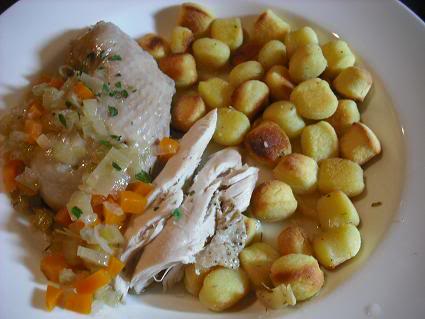
I ignored the serving suggestion of pouring the chicken and broth over rice, and decided to make another one of Nigella's dishes, the rapid roastini. Basically bought gnocchi, rendered into miniature roast potatoes by cooking in some oil. I added some rosemary and garlic, and they were just gorgeous with the tender chicken.

Nigella's breakfast bars were my next venture. Oats, nuts, seeds and fruit bound with condensed milk and baked. Minor tweaks - I omitted the coconut and doubled the amount of fruit, using sour cherries and blueberries instead of the cranberries, and I used lightly salted roasted cashews and peanuts as the nuts. These bars are absolutely wonderful. Not as sticky as a flapjack, they have just the right degree of sweetness for my taste, and are very, very sustaining. I will definitely make these again. Although I will line my tin with baking paper next time - oiling it wasn't quite enough.

Something odd about the praised chicken - we ended up with much more leftover than we do normally roasting the same sized chook. So I had loads of lovely leftovers to eat during the week; a large bowlful of cold chicken and a big tub of jellied broth.

I stirfried some of the shredded meat with home made Thai Chilli Jam, then added some noodles cooked in some of the leftover chicken broth. I had some pickled beanshoots & beetroot on the side to tone down the spice a little.

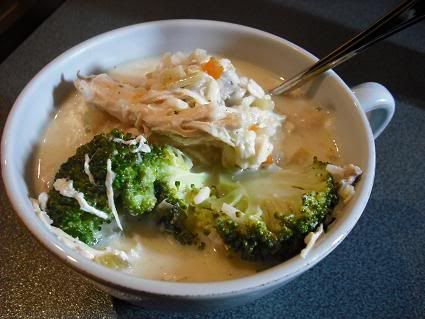
I cooked some rice in some leftover broth, then added some chicken and broccoli. When it was tender, I pulled it off the heat and stirred in an egg, whisked with a handful of parmesan and the juice of a lemon, for a sort of avgolemono/stracciatella comforting bowl of soup. And I still had enough chicken leftover for a sandwich.
Saturday, 9 October 2010

Frankenleaven

My friend Southy recently revealed that she has been making sourdough English muffins for breakfast. Well colour me impressed. I've been scared of sourdough. Half-understood ideas of having to keep feeding and halving the leaven, and the psycho baker in Kitchen Confidential screaming down the phone "Feed the bitch!", and people mentioning babysitting leaven while friends went on holiday left me feeling that sourdough was really not something I could undertake.

But Southy informed me that it wasn't really that bad, and pointed me towards Dan Lepard's sourdough, which is actually stored in the freezer and brought back to life when required (I did consider calling this post Disneyleaven, but apparently it is an urban legend that Walt Disney had himself cryogenically preserved).

I did have an anxious moment mid-way through the week, when I thought my leaven had died. It went from being bubbling and lively to completely silent and a bit dry- looking. I quickly signed up to Dan Lepard's forum, to get help with resuscitation, and my new best friend Dan informed me that it probably wasn't dead at all, but had exhausted its food reserves and that I should just keep feeding as per normal and all would be well. And gosh-darn it he was right.

I used 2 nuggets of the leaven fresh: one for the sourdough naan I made for the last Cook the Books challenge, and one following Southy's recipe for English muffins. Both absolutely wonderful and definitely to be repeated.

But I was really looking forward to bringing some frozen leaven back to life and seeing how that worked.

Pretty damn well, is how it worked! I followed-ish another one of Dan Lepard's recipes, for a sourcream sandwich loaf, using sourdough leaven instead of yeast, and Greek yoghurt instead of sourcream. Very successful! Perfect crisp crust, beautiful flavour, beautiful texture and absolutely magical aroma. Very much to be recommended.

Wednesday, 6 October 2010

Scotch Eggs

Just as I was saying that I can't keep up with all the different weeks, I read Mark Hix's column in the Independent and discovered that this is British Egg Week. I love eggs almost as much as I love cheese, so I am very happy that these two weeks come back to back in the calendar!

This gives me an opportunity to post about these lovely Scotch eggs. I made them months ago, but I've never really had the right moment to blog about them.

Apparently the name has nothing to do with Scotland, and is from scotched meaning chopped. I don't know whether that is true, but they are a very British snack food, and really wonderful for picnics. They have been sadly debased with cheap sausage meat and weird orange breadcrumbs, but made with fresh free-range eggs, nicely seasoned organic pork sausages and panko crumbs they are absolutely delicious. I used this recipe from the Hairy Bikers, but there is a lot of wiggle room to customise them to your own taste.

Sunday, 3 October 2010

Ultimate steak sandwich

On Friday, unusually, we were both at home. The weather was absolutely dismal (even Urchin accepted that it was too wet to be outdoors) and I felt that a good lunch was important for marking the occasion and lifting the spirits.

Now, when we have pub lunches, we both find it quite difficult to look beyond a steak sandwich. At one point I was compiling notes on the various offerings of the pubs in the area, but then I lost my camera with all the steak sandwich pictures and haven't picked up that idea again. But we both definitely Have Views on what makes a good steak sandwich.

Firstly, the bread has to be good. You are putting hot, juicy meat into it, so flabby white sliced bread is going to collapse to wallpaper paste in an instant. You want something with a bit of texture.

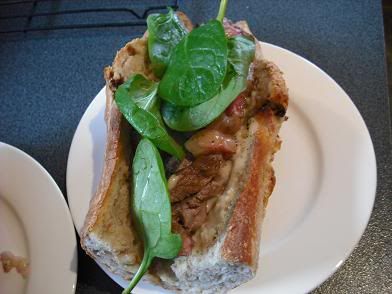
For my steak sandwiches, I pulled my last portion of baguette dough out of the freezer. I blanched and caramelised 6 or 7 fat garlic cloves and rolled them into the dough as I shaped my baguette. The crisp crust and tender, open crumb are just the thing, and the bites of caramelised garlic add interest to the flavour.

The second most important thing is of course the steak itself. You cannot make a good steak sandwich with those pathetic thin "minute steak" things. You need a good quality, thickly cut steak. It needs to be cooked (I cook mine a little bit more than I do ordinarily, because I don't like the blood-streaked bread look), seasoned well, rested and then sliced thinly.

And lastly, you need to think about condiments and additional fillings. Fried onions are a good thing. A few thinly sliced mushrooms, cooked in the pan with the steak are nice. A slice of tomato. A few rocket leaves. Chutney, or mustard, or mayonnaise, or mayonnaise AND mustard. The important thing is not to throw everything at it: just a couple of extra, complementary flavours so that the steak is still the star ingredient.

After a much longer conversation on the subject than most people would think necessary, we had a thick smear of horseradish cream and a few baby spinach leaves in with our steaks. Utter perfection with a bottle of Hoegaarden beer.

This heavenly sandwich is just the thing for Deb's Souper (soup, salad and sammie) Sunday SouperSundays so do pop over to her blog and see what other bloggers have been cooking up this week.

Friday, 1 October 2010

Saffron honey yoghurt mousse

I've recently been sent some TOTAL Greek-style yoghurt to try. And when I say some I mean there may actually be a global yoghurt shortage now, because it is all in my freezer! They sent their full-fat, 2%, fat-free and 2% with honey yoghurts to sample, so don't be surprised if yoghurt crops up quite a bit over the next few months. It's a good thing yoghurt freezes well.

To go with my Cooking the Books curry dinner, I decided to make an Indian-influenced yoghurt dessert. As it happens, we were far too full for dessert, so we ate it the next day.

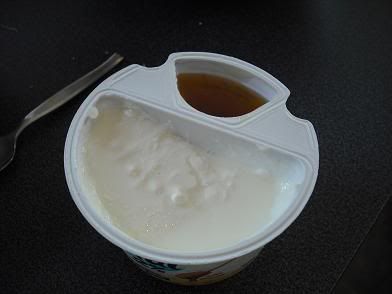
I decided to use the TOTAL honey yoghurt for my dessert. I was adding some cream to it, so having a lower fat content was a good thing! And when I tasted it, the honey was very strong and sweet, so I knew it would provide a good flavour and do away with the need for additional sweetener. It is actually a bit too sweet for me on its own, but in this mousse it is perfect.

Saffron Honey Yoghurt Mousse (serves 2)

1tsp gelatin
2tbs hot water
pinch saffron threads
1 tub TOTAL 2% yoghurt with honey
100ml double cream
1/2 tsp vanilla bean paste

Sprinkle the saffron threads over the hot water in a small cup and leave to steep for 5 minutes. Sprinkle the gelatine over the (now warm) water and leave to sponge for a few minutes. Warm half the cream in a small saucepan and add the saffron/gelatin mix, stirring until the gelatin has dissolved and the cream is streaked with gold. Remove from the heat.

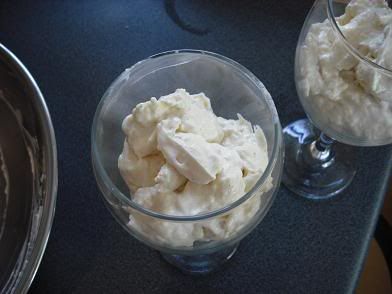
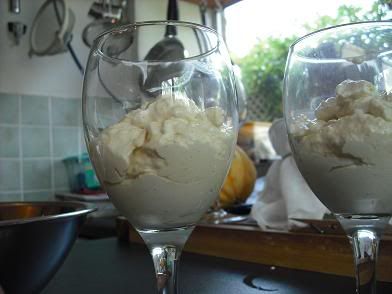
Whip the other half of the cream with the vanilla bean paste until it forms soft peaks. Fold in the yoghurt and honey, then fold in the saffron cream. Pile into 2 glasses and chill for a couple of hours until set.

Saturday, 25 September 2010

British Cheese Week

I can't keep up with all the national and international "Days" and "Weeks". On any given day it seems we are supposed to be aware of three diseases, two other worthy causes and a handful of professions, local foodstuffs and indigenous trees. It's too much, so they usually pass in a blur for me. But just today I discovered that it is British Cheese Week. As cheese is something I hold very dear to my heart (well, all my arteries really. And my thighs), I thought I really had to mark the week appropriately.

I happened on the British Cheese Board website while looking for a savoury muffin recipe. I decided that this recipe for cheese & sweetcorn muffins was just the thing. Although I did use fresh corn kernels, rather than frozen. And I replaced 80g of the flour with fine polenta. And I reduced the amount of butter because I added some crumbled, cooked chorizo. But essentially I followed the recipe! And they are delicious. The flavour is very well balanced between the corn and cheese, and the bits of onion and chorizo add interesting flavour and texture. They aren't too heavy either. Paul's taken some fishing with him and I am hoping that a couple will survive long enough for me to have them with a bowl of soup for dinner during the week.


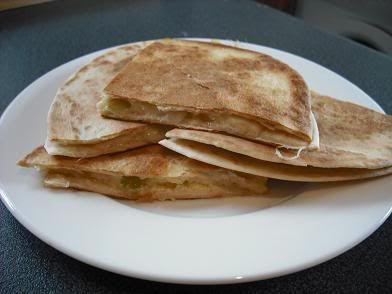
I also felt that I should make something to show that British apples are coming into season now, and that they go so very well with cheese. The Egremont Russet is a very good apple for this sort of thing, because the flesh is fairly dry so you don't end up with a soggy quesadilla, or juice running down your arm.

Cheddar and Egremont Russet Quesadillas

2 flour tortillas
1/4 Egremont Russet apple, thinly sliced
Handful British cheddar cheese
A couple of thin slices of onion
Freshly ground black pepper

Place one tortilla in a dry pan, add the thinly sliced apple, then the onion and freshly ground pepper, then top with a handful of grated cheese. Top with a second quesadilla. Cook gently on both sides until the cheese melts and the tortillas are browned and crisp. Slice into wedges and eat immediately. I think a glass of beer is the right thing with these!

Wednesday, 22 September 2010

Cooking the Books - Climbing the Mango Trees

Climbing the Mango Trees, Madhur Jaffrey's memoir, is the latest book for the online food-blogging bookclub, Cooking The Books.

I was aware of who Madhur Jaffrey was, although I don't think I have seen any of her cooking programs or her movies. I knew that she was considered very influential as one of the first people to popularise Indian cooking in the West, but I wasn't at all prepared for how gripping I found Climbing the Mango Trees.

As one of my favourite novels is Vikram Seth's A Suitable Boy, I found some familiar ground in Ms Jaffrey's story. But somehow the structure felt very much like recalling memories, which made the account seem much more real. The odd little insignificant details that you remember when thinking back made her memories very vivid to me.

I also found it fascinating from a historical point of view. To have heard Gandhi speak just a couple of days before his assassination is so extraordinary. And because I think of India as such an ancient culture, it's quite confronting to recognise how recently it was a British colony, and at what cost they gained independence. I hadn't realised the scale of the bloodshed at Partition.

One thing I did know is that the majority of "Indian" restaurants in Australia and the UK are run by Bangladeshis, Punjabis and Pakistanis. People who had found themselves suddenly dispossed at Partition.

It means that most of the food that I am familiar with as "Indian" has a distinctly Northern bent. The naan and tandoori-cooked foods that Ms Jaffrey found so novel with the influx of Punjabi refugees to Delhi are staples of Indian restaurants in the UK, but are just as delicious and enticing as she found them 50 years ago.

This is what inspired the dishes I cooked. I made mutton and spinach curry following Ms Jaffrey's recipe (very different from the one I usually make) which she describes as being like the curries her Muslim school friends had brought for lunch. I made her grandmother's delicious spiced cauliflower cheese. I made dhal (she says that at a pinch you can substitute Mexican black beans for the whole urad dal. It really isn't a great substitution and not one I would repeat). And I made naan.

Delicious, homely food with a history. You can't really ask more of a dinner; a fascinating story with wonderful recipes, you definitely can't ask more of a memoir.

LinkWithin

Related Posts Plugin for WordPress, Blogger...