Wednesday, 7 December 2011

Zebra cake unveiled

You may remember I recently posted a sneak peak of this zebra cake. You see, friends had asked me to make a birthday cake for their little girl, and I'd agreed, despite not being entirely sure I had the baking chops to carry off such a project.

Then I had to make a plan. I like planning.

I've had Grace's zorse cake bookmarked for months, because I loved the delicate stripes, but I knew that a cinnamon-flavoured cake was really not going to cut it for a bowling party of seven year olds. It had to be chocolate. Not too chocolatey of course - these may be modern middle-class kiddies but in my (limited) experience of children they are mostly about the icing and a dark, sophisticated chocolate cake would be wasted.

I turned to a brains trust of experienced bakers, and was recommended the Be-Ro Milk Chocolate Cake recipe. Now, Be-Ro produced the world's first self-raising flour. As far as I can tell, saying you are using a Be-Ro recipe gives the same sort of this-is-my-grannie's-recipe reassurance that the Edmond's cookbook gives kiwis or the Commonsense Cookery Book gives Australians. So despite the unusual technique (rubbing the fat into the flour, then adding the liquids) I knew I was in safe hands if I followed the recipe. Of course, I wanted to make it a zebra cake, so I wasn't going to follow the recipe, hence the need for the trial run, to see how my batter worked when divided.

As I'd decided to make a 10" cake, I also had to scale up the recipe - I made 1 1/2 times the batter. If I'd wanted to cut it in half to layer it, I would have doubled the recipe.

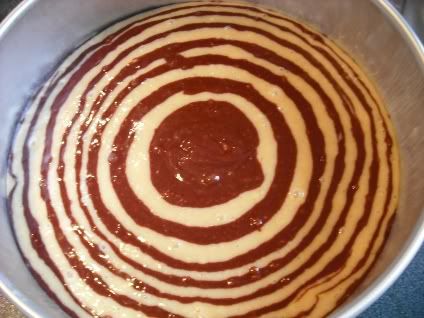
So I followed the recipe, using butter instead of margarine and omitting the cocoa until after I had divided the batter in half, then I thoroughly beat the sifted cocoa into one half. And I ignored the bit about not using a loose-bottomed cake tin. It's really a very thick batter, I don't know why they were worried about it running out!

I alternated portions of the batters, allowing each one to spread out naturally from the centre, and pouring the next carefully onto the middle of the preceding circle. Then I baked it at a slightly lower temperature, for slightly longer, testing a couple of times with a toothpick until it came out clean.


During my planning phase I'd done a LOT of reading about cake decorating. Most of which I confess made me want to run away screaming because it was so much more complicated than I wanted to attempt. There were a couple of cracking tips though:

a) put strips of baking parchment on your cake board just under the cake, so you keep it clean while decorating and don't have to try to move a decorated cake onto the board.

b) apply a "crumb coat" - this is a thin layer of jam or syrup (or booze if you aren't cooking for seven year olds) that you brush onto the cake. It adds flavour, moisture, and seals any loose crumbs to the surface of the cake so you get a clean surface to ice.

I used warmed, sieved strawberry jam, because some of the decorations I used were strawberry flavoured.


As well as knowing that the cake had to be chocolate, I knew it had to involve the colour pink. I am not a fan of the pink-for-girls thing and left to myself I would probably have taken a stand and decorated in pale blue or bright green to show what I think of gendered colours, but she's seven, she loves pink and she is not a puppet of my politics.

I thought about doing a white chocolate ganache, but white chocolate can be a bit temperamental and also tends to look quite yellow. I came upon this recipe, for a white chocolate buttercream, and thought that would be exactly the thing. I wanted an icing thick enough to completely conceal the stripy insides, so it would be a surprise when it was cut. I just did a straight swap of American to Australian cups, because I couldn't be bothered with the conversion, and used 200g white chocolate because that is how big the block was. I also didn't add any extra vanilla; I only had vanilla bean paste and the last thing a little girl needs is black-speckled frosting.

I urge you to try this frosting. It is absolutely delicious and extremely well-behaved. I think it will be my go-to icing forever more - I was thinking about how good it would be with coffee or some lemon zest added.

After that, it was pretty straight-forward. I smeared the frosting on liberally with a palette knife, then put some in a freezer bag and snipped off the corner, piping a rampart around the top edge of the cake, then adding little rosettes. Strawberry and white chocolate curls, pink sugar pearls, pink and white sugar flowers and a liberal dusting of edible glitter finished it off.


You know what? I was thrilled with how it turned out. It looks home made, not mass-produced, and very importantly, it tasted really good. The cake had a good, moist texture and lovely chocolate flavour (I used good quality cocoa). I don't see myself doing this sort of thing often, but I did enjoy the challenge!
Saturday, 3 December 2011

Lindy Wildsmith's Cured - all things salty meat

A couple of months ago I was sent a press release about the inaugural Festival of Cured Meats. It was billed as the first ever UK celebration and exploration of the world of charcuterie, which was pretty damn appealing to me.

Lindy Wildsmith was billed as one of the main attractions, demonstrating some techniques from her book Cured: salted, spiced, dried, smoked, potted, pickled and raw, so her publisher, who'd sent me the press release, sent me a copy of the book to play with too.

I confess, that I was a little disappointed by the reality of the Festival. It was on a much smaller scale than I had anticipated, there was no defining signage and it all felt a bit slapdash. We wandered around Southbank for a while, trying to see if there was another section of market tents that looked more Festivalesque before realising that no, that was it.

On the other hand, there was a Polish sausage stall pumping out absolutely dynamite lunchboxes. My grilled, smoked sausage, dill-redolent potatoes, salad and pickles was just what was required on a cold autumn day.

We stepped into the small "main tent" for what was billed as a French pate tasting and was in fact high comedy. Apparently the producer had been approached to participate, couldn't be bothered and sent a few tins of pate over. So they were plonked on the tables with about as much ceremony they deserved and a friendly passing French man was coopted to read the labels for us.

Then it was Lindy's turn. She demonstrated a couple of techniques from her book and passed around samples to taste. Lindy was very warm and engaging and made everything look very accessible, but there wasn't anything particularly new for me in it. The most interesting thing, for me, was the audience. There was a group from The School of Artisan Food - which I had never heard of and now I want to go - and a woman with the most extraordinarily dissatisfied facial expression. It was amazing. It was like every time she tasted anything she put her whole being into showing how much she disliked it.

After the demonstration we did a bit of shopping, picking up some smoked cheese from Artisan Smokehouse and some gorgeous ham and salami from Cannon and Cannon.

Then it was home to play with my copy of Cured.

It's a pretty good starting point for a beginner I think. Not a lot in the way of outlandish ingredients or equipment, very clear explanations and good general principles that you can apply. It's not going to replace my other preserving books, but it certainly deserves a place alongside them. The duck confit, streaky bacon and salt beef that I made were all very successful.

Thursday, 1 December 2011

If you can't say anything nice, don't say anything at all


The Worship Street Whistling Shop. This is the Panacea cocktail. It's very nice. I can't say anything about the service, ambiance or other beverages...

Tuesday, 29 November 2011

Food Bloggers Unplugged

I've been tagged by Suelle of Mainly Baking, for this fairly nifty questionnaire that is doing the rounds at the moment. Initiated by Susan from A Little Bit of Heaven on a Plate, it's a little Q&A designed to get to know your fellow food bloggers a bit better. And it gives me a post without requiring actually cooking anything, which is a nice change.
So. Your first starter for 10...

What or who inspired you to start a blog?

I think it was my husband. He is much more internet savvy than me and thought it was a good idea. I think he may have thought it would stop me from talking about food so much, but if that was his aim he has sadly failed.

Who is your foody inspiration?

I couldn't possibly narrow it down! My mother, other bloggers, cooking shows, magazines, restaurants where I eat, books that I read, ingredients that I come across. They all inspire me to cook and eat and cooking and eating inspire me to write.

Your greasiest, batter-splattered food/drink book is?

Australian Women's Weekly Italian Cooking Class Cookbook
. The page that has both spinach with spirali and pasta puttanesca on it. Plus I am onto my second copy of Elizabeth David's French Provincial; I read the first copy to rags, although I don't really cook from it.

Tell us all about the best thing you have ever eaten in another country, where was it, what was it?

There's good food everywhere! How can I choose? Chilli crab in Singapore, garlic soup in Switzerland, chawan mushi in Hong Kong. But having spent most of my life in Australia it has to be something there, but I couldn't say exactly what!

Another food blogger's table you would like to eat at is:

I think Leaf, the Indolent Cook. She has this lightness of touch and extraordinary originality with ingredients that I find awe-inspiring.

What is the one kitchen gadget you would ask for this year (money no object of course)?

I'd really like a microplane nutmeg grater.

Who taught you how to cook?

My mother.

I'm coming to you for dinner, what's your signature dish?


I don't have one. When I have people over I try to cook something that fits with what I know of their tastes. But dessert will probably be something cold and creamy, like a pannacotta or a fruit fool, and if artichokes are in season there will definitely be artichoke fritters with cava to begin.

What is your guilty food pleasure?

I don't feel guilt about food. I think it is unhealthy to attach those sorts of judgements.

Reveal something about yourself that others would be surprised to learn?

I'm not very picky really. People say they are scared to cook for me, but it is totally unnecessary - I am just happy to have a night off cooking myself!

Now, in theory the next step is to tag 5 other bloggers - which I am not going to do. I want to hear what all of you have to say, so please consider yourself tagged!


Sunday, 27 November 2011

Cooking the Books: tisane for Harlot's Sauce

Harlot's Sauce: a memoir of food, family, love, loss and Greece, by Patricia Volonakis-Davis, is the current Cook the Books bookclub selection.

Patricia's account of her marriage to a Greek man is really quite something. I couldn't put it down. This, unusually, is not a recommendation. I kept turning the pages waiting for things to get better for her. I held out hope for a while that she wouldn't marry Gregori, although I could see from her name that she'd been married to a Greek at some point. Then I held out hope that the marriage wouldn't last long so she could be happy. No luck. Just when things start to look up, the book ends.

One bit I did find amusing, though, were all Gregori's cousins, because it reminded me of the 1980s "Con the Fruiterer" sketches on Australian TV, where he talks about his daughters Roula, Toula, Soula, Voula, Foula and Agape.

Unusually for a "food memoir" I can't think of a single positive association with food in the book. This is not a book of lavish feasts bringing families together. Constipation from toasted white bread sandwiches on her first trip to Greece, food used to control and manipulate when Patricia and Gregori's families first meet, Gregori's dismay at the story of the puttanesca recipe, Gregori's friend being rude and dismissive over hamburgers, etiquette dances surrounding biscuits at his uncle's name day, Gregori cooking beans every day in protest, criticising her salad making... it is all food as a weapon, lacking joy.

What, then, to cook to represent this book? I thought about making some good Greek food. A delicate and delectable galaktoboureko, a nourishing, cheesy spanakopita, a life-enhancing platter of meze to share with loved ones.

But finally I decided to make a simple tisane. Dried lemon balm and fresh mint, infused in boiling water until fragrant and served with a touch of honey. Good for the digestion, soothing for the soul.

Friday, 25 November 2011

Product review: Colman's Instant Gravy


I'd seen the extremely irritating TV ads with the gurning gelatinous bull dancing around the kitchen counter before diving into a gravy boat. It did what a good (if irritating) ad should - made me recognise the name and have a passing curiosity about the product - so when I was offered a chance to try them, I was keen. Or rather Colman (that's a mustard joke, for those playing at home).

*Usual disclaimer*: product was provided free of charge, no other compensation was offered or accepted, views are my own and the PRs don't get to vet my copy before I publish.


Firstly, the beef flavour: this was an extremely thick paste, really difficult to squeeze out of the tube. I had a moment where I was concerned that the top of the tube was actually going to explode, but eventually I got a portion out.

The aroma of the paste itself was pretty indistinguishable from Bovril, but there is nothing wrong with that. I like Bovril.

Made up as per the instructions on the tube (add boiling water and stir) it made a very thin gravy, so I had to add quite a bit extra to get it to the thicker consistency I prefer.

The colour was good, and it had a strongly beefy, "clean" flavour. An excellent accompaniment to steak and veg and a very good substitute for home-made.


Paul has been promising for some time to make me a beef pie, with handmade shortcrust pastry, so this seemed like a good opportunity to put him to the test. He made a beef, ale and mushroom stew, using the beef gravy paste to add body to the sauce. He made a butter shortcrust, in a 2:1 flour:butter ratio, and it was absolutely divine. He has a much better pastry hand than I do, so I throw in the towel and will stick to bread.


The onion flavour: Also very difficult to squeeze from the tube, slightly ruddier colour than the beef. Slightly acrid, dried onion aroma, which unfortunately took me back to pot noodles.

When made up, the dried onion note was less evident, but still there. Made the dinner of deconstructed toad in the hole and frozen veg taste even more institutional than it looks. My Yorkshire puddings are coming along nicely though.


I gave the onion gravy a second chance, cooking down a sliced red onion with some thyme and black pepper and then adding the gravy paste and water. We had the onion gravy with celeriac and swede mash, and faggots, for a really hearty winter meal. Unfortunately the dried onion flavour couldn't be disguised.


The chicken flavour: Softer and easier to squeeze than the other two. On its own the paste has a slightly "roast" chicken aroma, pleasant.

Made up, the gravy was much thicker than the others, I needed to dilute it more to avoid a really gelatinous texture. There was a bit of a herbal scent to the gravy, maybe a bit of rosemary and thyme? It also had a faintly floury texture on the tongue, although this wasn't evident when it was served. It made a very good accompaniment to roast chicken thighs, potatoes and baked gem squash.

In short, the onion flavour is not worth bothering with. I don't like wasting food but I will be throwing the remains of that tube away. The other two are worthy of house space. These pastes really do have a better flavour and texture than granules or powder. All the ingredients are pretty innocuous, with no E numbers to scare you off, which I like. Making gravy from scratch is hardly arduous, but this is a useful product if you don't like gravy or don't like making gravy and others in your family do. I am a much bigger fan of gravy than Paul is, so I can see myself using these to make a little pot for one sometimes.

Wednesday, 23 November 2011

Home Smoked Paprika


I did say there was one more chilli post! I think this has really been the most exciting discovery of the 2011 chilli season - home smoked paprika.

We'd decided that we wanted to have a crack at smoking and drying the ripe Hungarian Hot Wax chillis. I gave them a rinse (to get rid of clinging cat fur - a natural hazard in our conservatory) cut a slit in each one to help the smoke penetrate and the flesh dry out, then hot smoked them over beech smoking dust for an hour.


After smoking them, they had a lovely aroma, but they were still very fleshy and "wet" - not good for keeping. I laid them on baking parchment and dried them out in the lowest possible oven, turning them a couple of times, until they were thoroughly desiccated. I let them cool before packing them in a net and hanging them up - so that air could continue to circulate around them.

I cut the stem off one and ran it through the spice grinder, in order to do a direct comparison with commercial pimenton. Other than the texture, which wasn't as fine, and the colour, less of a vibrant red, ours was a definite winner. It had a richer, sweeter, smokier aroma (very much, in fact, like really good bacon) and a more well-rounded flavour with a subtle heat to it. The commercial pimenton had a slightly acrid note at the back of the throat. Ours really is lovely stuff.


We tend to use a lot of pimenton, so we've been using our own wherever we would normally use commercial pimenton. A whole, smoked chilli, deseeded and sliced, makes a glorious addition to Nigella's bacon and tomato hash. Served with an omelette stuffed generously with pesto.


Sprinkled onto potatoes rubbed with olive oil, strewn with garlic and fresh thyme, it makes pretty much the best roast spuds ever...


... and better yet with chicken thighs nestled into the spuds and also sprinkled with the wondrous powder. With Jamie Oliver's tomato and chorizo salad on the side. An utterly perfect combination.


We have also been using our own chillis whenever a recipe called for chipotles. I got this carne con chilli recipe from Kavey, although I used ox cheeks (and didn't sieve the sauce - it was too good to waste!). I used a mixture of bought ancho chillis and smoked and dried hot wax. Divine flavour. The first night we had it with green rice (made from Tommi Mier's recipe - according to the blogosphere the proportions in the recipe are wrong, but mine turned out perfectly) and the second the leftovers were rolled into enchiladas. Delicious and comforting. And very superior, due to my divine chillis, naturally.

LinkWithin

Related Posts Plugin for WordPress, Blogger...