Showing posts with label balderdash. Show all posts

Thursday, 14 August 2014

Häagen-Dazs - real or nothing

One of the things that dismays Paul about me is my love for ice cream. He doesn't see the point and doesn't get why I love it so. He does have a point, of course: it increasingly looks like sugar is seriously damaging to your health. So, despite the beautiful weather, I have been turning down very kind offers of ice cream samples and I didn't take part in last month's BSFIC challenge.

Eventually and inevitably, I got an offer too good to refuse. The chance to attend a lunch, cooked by a Masterchef winner, to launch the Häagen-Dazs summer campaign. As I don't actually watch Masterchef, I had no idea who Natalie Coleman was, but it sounded impressive. Plus the event was being co-hosted by Great British Chefs and I bloody love that site.

When I arrived, a little late and a little discombobulated, I was shown to a roof terrace and plied with booze. A good start. They were serving cocktails designed to fit in with the ice cream flavours, so I started with a Rossini, which went down very easily and followed it up with a salted caramel martini. Then we were invited down to watch Natalie demonstrate how to make a classic vanilla custard-based ice cream. The emphasis for this Häagen-Dazs campaign is real ice cream, showcasing the natural ingredients they use, hence showing us how to make it from scratch.
 Nothing ground-breaking, although she did share a useful tip about gently rolling vanilla pods on a board to help release the seeds.
"nestergen leaf" = nasturtium - and I don't know who got the crab, but it sounded good!
More drinks, and then it was lunch time. To match the real ice cream were dishes featuring real eggs, milk, cream and butter. So delicious but good lord it was all very rich. To the point where it didn't really leave me in a great frame of mind or palate for tasting ice cream.
We started with duck egg yolks, confited in olive oil in the oven (no sous vide gadgetry!), served with green and white asparagus, hollandaise, nasturtium leaves and a generous shower of white truffle shavings.
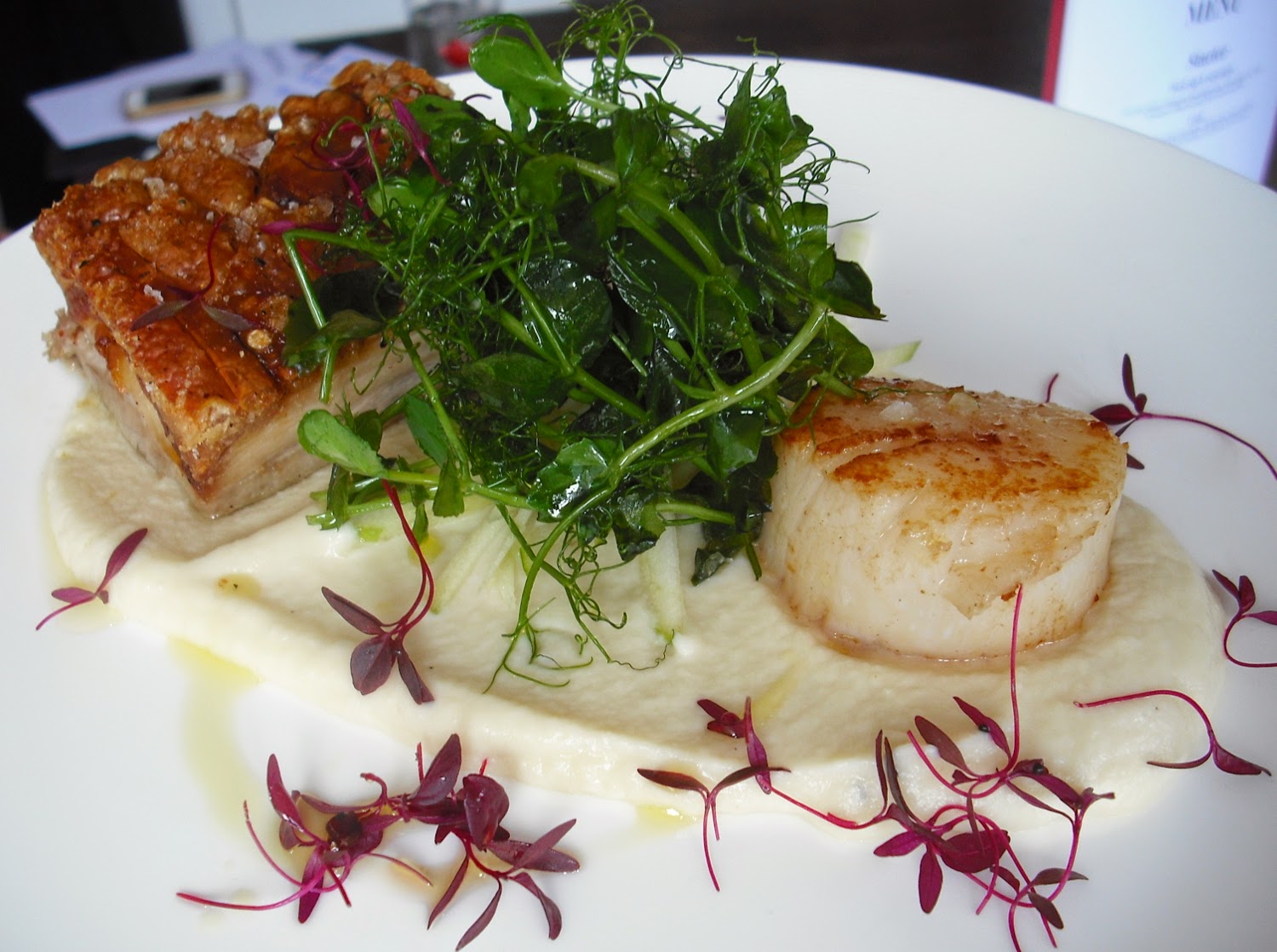
Then more richness, in the form of meltingly tender, crackling-topped slow-cooked pork belly on a pillow of smooth, buttery cauliflower puree. A fat, sweet scallop was separated from the pork by a very welcome tangle of green apple and sharply dressed pea shoots. It was a bit too salty for my taste, and, although it was beautifully cooked and presented, I think I would have enjoyed it more had it not come just after confit duck egg and hollandaise. I envied Kerstin Rodgers/Ms Marmite Lover her vegetarian option - the pumpkin ravioli looked superb.
The vegetarian option
Natalie's ice cream was simply presented, with bowls and jugs of accompaniments for self-service. I garnished mine with a handful of roasted macadamia nuts and a pool of salted caramel sauce.
Then the serious fun began. Nadège Le Pennec, from the Häagen-Dazs R&D team, handed around a bowl of sugar and told us to put a bit in our mouths, while blocking our noses. I noted the teensiest bit of eye-rolling around the circle as we all did as we were told, and all thought "Sugar. Big deal". Then Nadège's magic trick as we unblocked our noses and discovered that the sugar was heavily scented with cinnamon. Completely undetectable just on the tastebuds, but revealed as soon as we let go of our noses.
Next came a blind tasting of four different vanilla ice creams. Two were pretty dreadful, with no aroma, an icy, milky texture and a taste that vaguely skirted around vanilla without actually hitting it. The other two were dense and creamy, a bit eggy, with enough aroma to survive freezing and a true vanilla flavour. We were split fairly equally between those two, when we were asked to guess which one was the Häagen-Dazs. Those of us who were wrong (...me) couldn't feel too bad about that though, because the one we picked... was Natalie's home-made. Pretty compelling, I thought.

The event drew to a close with opportunities to taste all the flavours, which I was in no state to appreciate, and we were sent home with little wicker hampers of the ingredients for real ice cream and Natalie's recipe.

I found it all interesting, because I didn't know anything about Häagen-Dazs prior to this. I remember when they launched in Australia in the late 1990s, and being vaguely aware of a "But they aren't even Danish, how can you trust them?" controversy. Which I don't entirely understand now, because they never claimed to be Danish - they are quite proud of their Brooklyn roots. So what with one thing and another, I'd never paid any attention at all to the brand. Now, well, it may have been lots of alcohol before lunch and the aroma of freshly grated truffle, but I totally drank the Kool-aid.

Which meant that when I saw this quote from Matt O'Connor of the Licktators in our local magazine, I bristled: 
Optima magazine No. 550 August 2nd 2014
"Milk protein powder, coconut oil, and a lot of air is what you are buying with Häagen-Dazs and the like. I'm amazed they can get away with it. Still, that's the Food Standards Agency for you," he says grimly.

So, as a little comparison, here is a screenshot of the Häagen-Dazs ingredients list for their vanilla ice cream, as sold on Ocado.

Fresh cream, condensed skimmed milk, sugar, egg yolk and natural vanilla.

And here is a screenshot of the Licktator's vanilla ice cream:


Wow. He really showed the big boys what real ice cream was all about, hey?...

So, to get rid of the taste of sour grapes, here is a recipe for one of the cocktails I particularly enjoyed. To be drunk with real ice cream, or by itself.

Salted Caramel Martini

35ml Butterscotch Schnapps
35ml Vanilla Vodka
15m Dry White Vermouth

Shake over ice and serve in a cocktail glass rimmed with salt

Edited to add: Daniel Young, of Young and Foodish, asked the Licktators on Twitter to comment on this comparison, and they stated that they were misquoted by Optima, that they were commenting about "Fake 99" ice cream in general.

Tuesday, 15 October 2013

The Bluffin Loaf

Last week's Big Food Story was that Starbucks launched a new bakery item, a doughnut/muffin hybrid they were calling the "duffin". Only problem is that Bea's of Bloomsbury have been selling duffins for almost three years. Starbuck's described their duffins as "filled with a raspberry jam; we’ve added just a hint of nutmeg to our buttermilk base and then covered it in sugar once baked". Bea's ingredients include nutmeg, buttermilk and raspberry jam - she published the recipe in her cookbook in 2011. Even that seemingly-blatant appropriation wouldn't have been a big deal necessarily, except the factory who supplies Starbucks trademarked the name, claiming they couldn't find a prior use.

The outcry was swift and loud. It got a lot of media coverage (each of those is a separate link). Starbucks adopted the position that they never said Bea's would have to stop using the name. Which I suspect means that they just hadn't got around to sending her the cease-and-desist letter yet, because they definitely have form for going after the little guys. And anyway, why would you register a trademark if you had no intention of protecting it?

So Starbucks manages to look even worse than usual and Bea looks like a plucky but modest hero for standing her ground and wanting the name duffin to be available for use by everyone.

I don't patronise Starbucks, making a boycott from me a bit of an empty threat, but I was pretty keen to be on the side of the angels for this one. I popped into Bea's on Thursday to buy a couple of the controversial cakes. I was actually a bit surprised they had any left, but the young woman who served me said they were on their third bake for the day because they are so hot right now. And I tell you what, they are absolutely delicious. The subtle hint of nutmeg and crunchy sugar coating makes them taste doughnutty, but the texture is like the lightest, moistest muffin and the raspberry jam gives a good tang.

So over the weekend when I felt like baking, Bea's duffins came to mind. I don't actually have her cookbook, but I do have Nigella Lawson's How to be a domestic goddess, containing a doughnut muffin recipe. I read Nigella's recipe and was unsatisfied by the lack of buttermilk and nutmeg. I flicked through the rest of the book and saw Nigella's blueberry buttermilk muffin recipe.
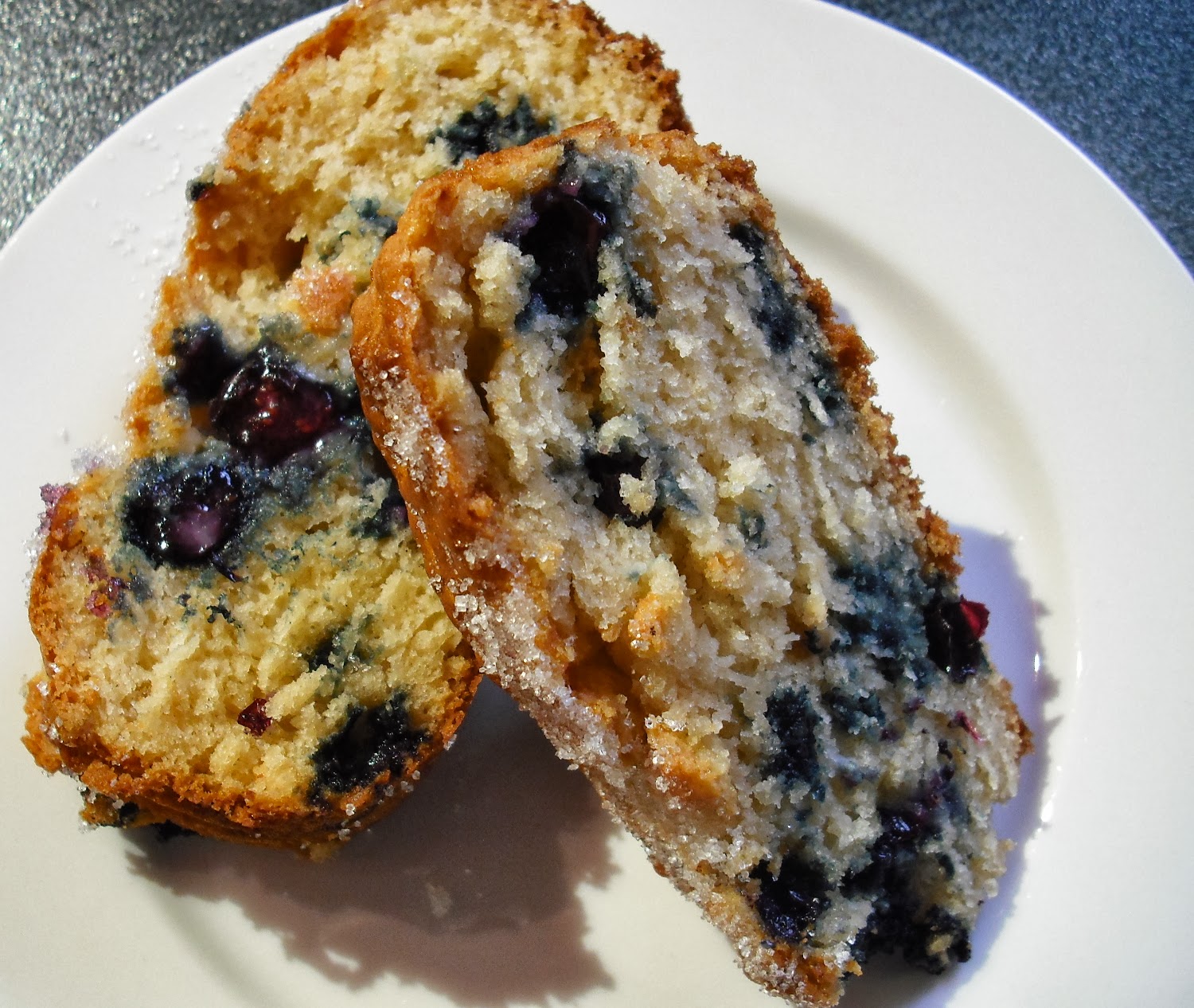
Conveniently, I had a punnet of blueberries. I stuck the two recipes together, reducing the raising agents, adding a good grating of nutmeg, and baking it in a loaf tin and created... The Bluffin Loaf. Which was a great success, although I could have been more heavy-handed with the nutmeg. I will not be attempting to register the trademark.

Thursday, 12 September 2013

Two meals inspired by Jamie Oliver

A couple of weeks ago, I was perusing youtube while I ate my lunch and came across an episode of Jamie Oliver's 15 minute meals. To be honest, when that series first aired, I didn't pay very much attention because I like cooking too much and never have the time pressure to produce a meal in only 15 minutes. But the sausage gnocchi and warm bean salad looked really delicious, so I decided to give it a go.

Then of course I realised that if I did both dishes we'd have loads of leftovers, so I decided to split them over two meals.

The sausage gnocchi, even though I reduced the fennel seeds to just less than 1tsp, was way too fennel-y. I think 1/2tsp of toasted and slightly crushed fennel seeds would have been nicer to eat. It was also very soupy. I think if I make this again I won't pre-cook the gnocchi, just let it poach in the sauce. I wasn't timing it, but this can't have taken much more than 15 minutes to make, because Paul was very surprised that tea was ready so soon.
The bean and greens salad was a great accompaniment to a barbecued onglet, although I think I would have preferred it to be just beans or just cabbagey things, rather than the combination. It would also make a nice meal on its own, with some good bread and butter.
These were both good dishes to add to the repertoire. I think this really is Jamie Oliver's strength - he is a very good cookery teacher, and has very good ideas about combining flavours in very approachable ways. If he sticks to that instead of saying ignorant and inflammatory things about poverty, I think it'll be a good thing.

Thursday, 28 February 2013

Lasagne and a very long rant


"Grandmother, may I have another sausage?" asked Hugh Anthony.
"Certainly not," said Grandmother.
"Why?" asked Hugh Anthony.
"Because you've had two already."
"But why can't I have three?"
"Because three wouldn't be good for you."
"Why?"
"Because they are made of pork, and too much pork is not good for children."
"They aren't made of pork. Sarah says Mr King's sausages are made of horse. So may I have another?" Sister of the Angels Elizabeth Goudge, 1939.

There's horse meat in prepared meals you say? Cue the proliferation of jokes. So very many jokes. Enough that the jokes are reported almost as much as the latest developments. But it isn't very funny really. For one thing, it's not just horse meat of unknown provenance. Pork, prohibited by Muslim and Jewish dietary laws, has also been found in these "beef" products. And there have been suggestions that the horses may actually have been donkeys.

Aside from the jokes, I've seen mainly three categories of responses: serves you right for eating meat, what is wrong with eating horse anyway and what did you expect from value meals?

There's not really much I can say about the first. Some people who choose not to eat meat are very keen to proselytise. They have a point - I'm sure most people would benefit from eating less meat (particularly highly processed meat products) and more vegetables. It probably would benefit the planet, too. But I honestly don't think that many people who do eat meat will stop as a result of this, although sales of frozen beef (or "beef") burgers have fallen.

The "what is wrong with eating horse" school also gets short shrift from me, because it is just fundamentally missing the point. If you choose to eat horse, there is nothing wrong with it. If you don't choose to eat horse and you end up doing it anyway, that is the problem.

It's the "Well what did you expect from value meals" response that has me really wound up.

Where to begin?

Firstly, what I expect is that it "does what it says on the tin". I expect "made in the UK" to be made in the UK. I expect gluten-free bread to be gluten-free. I expect food labelled "suitable for vegans" to be suitable for vegans. And I expect something labelled 100% beef to contain 100% beef, whether it is from an economy range or premium. The problem with horse or pig or donkey or rat being substituted for beef is a matter of fraud. Laws are being broken by selling one foodstuff as another. The Food Labelling Regulations 1996, a bunch of EU regulations and directives, all dealing with maintaining a safe food-chain and ensuring that food is labelled accurately. There are suspicions that some of this is down to organised crime  - it isn't just a mistake or the consumer not being careful.

Secondly, this has opened up a whole nasty can o' worms regarding attitudes to the poor. The snobbery that has been on display is absolutely grotesque. From the smug "I never eat ready meals" to the more vicious pervading messages that you have to be both stupid and lazy to buy cheap meat, the horse meat scandal has led to a lot of victim-blaming. Often prefaced with "why don't they just...".

Why don't they just cook loads of lentils, shop at markets, buy from butchers, buy in bulk? My friend Miss South has eloquent things to say on the subject of food poverty, which are well worth reading as a rebuttal to those.

Cucina povera just isn't enormously suited to urban living. You can probably get chicken carcasses and secondary cuts for pennies and make lots of nourishing dishes from them. If you aren't working all the hours that the butchers are open. If you don't have family members with complex health needs and no respite care. If you have a butcher that actually breaks down whole animals and doesn't buy them in pre-packed. If you aren't reliant on a microwave because the landlord won't fix your cooker. If you can afford the fuel for long slow cooking. If you aren't spending all of your energies trying to get your benefits reinstated while undergoing chemotherapy.

I love the idea of taking my tangier to the local hammam and leaving it to cook all day in the fires underneath the bath house, but Greater London isn't really set up for that. I'd like to see the look on their faces if I rocked up to the local Wenzel's and asked them to stick my lamb boulangère in their oven for the day. I'd probably also get some funny looks if I went cutting firewood in the park in order to fuel my jambalaya-cooking.

Criticising people for buying the cheapest protein they can, when one in five mothers is missing meals so her children can eat, when the UN is investigating UK food poverty, when children are increasingly going to school hungry, is offensive and ignorant. Demonising people who are not in a position to make better choices is not going to help them.

What is the answer? Unfortunately that is where my ranting falls down. I just don't know really. Children are going to be given cooking lessons but since this has been discussed since 2008 I'm not holding my breath. Unless underlying issues of poverty are addressed, knowing how to cook ingredients that people can't afford isn't going to help. It probably won't hurt though.

For me, this lasagne was a very frugal dish. I didn't have any pasta in the cupboard but I did have eggs, flour and the equipment and know-how to make them into pasta. I have a large and well-stocked freezer, so was in the luxurious position of having organic British minced beef and pork, bought when they were on special offer. And I have time on my hands and a paid-up electricity bill so was able to give the sauce a nice long simmer. For the price of some spinach and milk, I was able to produce six hearty portions of food. In short, this is the sort of food people on a budget should be eating, if we ignore what real life can be like. But it actually didn't taste as good as Findus.

Spinach lasagne sheets made according to this recipe
Thin layers of ragu and bechamel
Warming, comforting lasagne


Sunday, 8 April 2012

Yeasted sweet breads and copyright kerfuffles


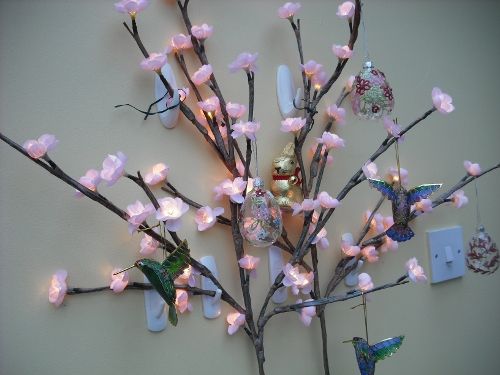
The Easter Tree is back!

I've been wanting to write a post about sweet breads for a while, because I have been doing a bit of work on them, plus it ties into some skermishes that have been taking place in the blogosphere lately. A long weekend seems like a good time to share my thoughts.

Recently some bloggers have been getting their knickers in a twist about being asked not to reproduce copyrighted material. I'm sure this happens a lot, but I have been particularly aware of it because Dan Lepard's representative David Whitehouse has been kicking a hornet's nest by asking people not to publish recipes from Dan's books. Many of the bloggers are graciously saying "mea culpa" and removing the content. And many others are hissing and spitting and taking to forums to complain about what a big meanie he is, citing bits of copyright law from various sources, talking a lot of bollocks about SEO and claiming that because they altered a method or used nutmeg instead of cinnamon the recipe isn't covered by copyright and that Dan has no right to claim ownership.

The thing is, this is a pretty fucking
immoral approach to life. Does "no, this isn't your car, I painted this one blue and yours was green" seem like a reasonable defence for car theft?

I could publish Dan's recipe for Cranberry oat bread, claiming it is different because I added a couple of spoonfuls of sugar, used a mixture of cranberries and sour cherries and slashed the top before the second rising. But that would be pretty
egregious behaviour given that I slashed the top at the wrong time by mistake, and as you can see it really doesn't work amazingly well my way. The bit of extra sugar was nice though.

The bit that really sticks in my craw about some of these people is the disingenuous nature of their argument. They say they have changed the recipe enough to make it their own, yet they are publishing it using the author's name. They are asserting the right of the author to be identified as the author of the recipe while at the same time saying he has no right at all. Utter nonsense.

I've found Paul Hollywood's iced finger bun dough to be a very useful jumping off point for making sweet yeasted breads, and I do think the breads I have been making are different enough from the original recipe to be considered an entirely new beast.

I've used the dough as written but divided into 4, rolled it out into logs filled with cranberries and plaited it, to give 4 channels of fruit through the middle of the bread.

I've left out the butter completely, replaced the milk with coconut milk and added a hint of coconut essence to the dough, then roasted some under-ripe fresh mangoes with lime juice and palm sugar until sweet and sticky and plaited that into the dough.

Both ways were very delicious, although it was a bit challenging to bake - these plaited loaves need quite a long bake to cook through.

I used the same dough recipe as a starting point for this morning's buns. I didn't want to make hot cross buns, but I think we can claim that the spiral shape of these is symbolic of the returning sun in Spring.


Easter Cinnamon Buns (makes 12)

500g strong white bread flour
2tbs caster sugar
2 large eggs
2 sachets instant yeast
1tsp salt
150ml warm milk
up to 140ml water
150g dried berry mix
100g butter, softened
2tbs cinnamon
2tbs caster sugar, extra
2tbs dark muscovado sugar
1 orange

Glaze

150g soft cream cheese
150g softened butter
1/4 cup icing sugar

Combine the flour, sugar, salt, yeast, eggs and milk in a bowl, adding enough of the water to make a sticky dough (my eggs were really big, so I hardly needed any water) and knead for a few minutes until it begins to come together, then add the dried fruit and knead for another 5 or 6 minutes until it is smooth (with the knobbly bits of fruit, obviously) and elastic.

Cover the bowl and leave to rise in a warm place for about an hour.

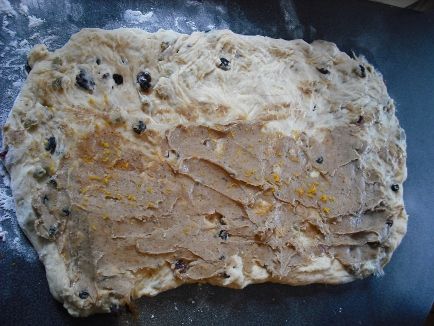
Cream the butter, sugars and cinnamon together to a thick mud. When the dough has doubled in size, tip it out onto a floured surface and stretch out into a rectangle. Smear the cinnamon butter over 2/3 of it, then grate the orange zest over the cinnamon butter. Reserve the rest of the orange to add to the glaze.

Roll tightly from a long edge and cut into 12 spirals. I find the easiest way to get even portions is to cut the log in half, then quarters and then each quarter in 3.

Place them, cut side up, in a pyrex lasagne dish, cover and leave to rise again until they double in size. I did this in the fridge over night.

Bake at 200C for about 35 minutes.

While they are baking, cream together the glaze ingredients and add
the juice of the orange. After about 30 minutes, when the buns are very nearly baked, pull them out of the oven and spread the glaze over the top, then return them to the oven for another 5 minutes. I got distracted by twitter and left them in for a bit too long, but 5 minutes is really the right length of time.

Allow to cool for about 10 minutes before eating.

Friday, 1 August 2008

There is a great disturbance in the blogosphere

I'm a bit late jumping on this bandwagon, but this is outrageous. To summarise, a blogger called Melissa made a potato salad, inspired by a food site's potato salad. She modified it in a few ways, wrote it up her own way and gave them credit. Then she got a notice telling her to take it down because this mob don't give permission to reproduce recipes because theirs are tested and perfect.

How ridiculous. Is there a cook in the world who hasn't used almonds instead of hazelnuts because that was what was in the cupboard? Or used basil because their family doesn't like coriander? Or stuck the pot in the oven instead of stirring it on the stove? And then decided they preferred it that way. We all have. My cook books are littered with handwritten amendments "takes longer", "use half water half lemon juice", "good with beef as well". When my mother sends me recipes for things she usually tells me what the recipe says as well as what she did differently. That is how cooking works. You taste stuff, you change stuff and you share it.

The cooks I don't like are the mean-spirited ones. The ones who won't tell you a recipe, or who leave out an ingredient because they don't want you to get it right, or who tell you they followed x recipe without telling you that they used 3 different ingredients and a totally different method.

So leaving aside the patronising tone the PR person took with Melissa, or the legality of copyrighting potato salad, the approach they have taken is terribly miserly and entirely against the whole spirit of generosity and love that underpins cooking. Have they not read Like Water For Chocolate? I'd never even heard of these people before, but I am determined that they will not undermine the way I do things - eating the way I like to, taking inspiration from wherever I can find it and passing on everything I learn.

LinkWithin

Related Posts Plugin for WordPress, Blogger...