Showing posts with label casseroles. Show all posts

Monday, 21 September 2015

Yes, Chef! Doro wat and injera

I first heard of Marcus Samuelsson from Joanne's blog - she was publishing some of her recipes on his blog. And shamefully I didn't pay very much attention. They were her usual healthy but delicious-sounding vegetarian dishes but I never looked into who this Marcus Samuelsson was. If I had a mental image of him I guess I imagined he was a vegetarian chef from Minnesota or something. Then I saw an episode of The Taste and realised that he was definitely not a vegetarian from Minnesota.

It meant that I was delighted when his memoir, Yes, Chef!, was chosen as the latest Cook the Books Club selection. And the story of how an Ethiopian child was raised in Sweden and became a celebrity chef in New York is really quite something. In a Sliding Doors scenario there are so many little twists that could have changed everything - if his mother hadn't made it to Addis Ababa, if his grandmother hadn't taught him to cook - so many factors came into play, but Samuelsson's determination is the thing that shines through.

Having read Helen Graves' posts about visiting Ethiopia with World Vision, and the process of making injera, I was pretty keen to have that as part of my Cook the Books contribution. I discovered that Ocado sell teff flour in tiny quantities, but it was enough for me to have a go.

I followed this method, using 23g of teff flour and 60 ml water for a half quantity, every time it specified 1/3 and 1/2 cups. I did a seven day ferment, and it behaved perfectly. It bubbled when the recipe said it would bubble and had a fermented, grassy aroma when it was supposed to. I didn't do the bit with the food processor, because the flour was very finely milled and there wasn't any grainyness to get rid of.

The final addition of the self-raising flour was fascinating. This was my mixture when I added it - sitting just below the 400ml mark.

And this was the mixture a couple of hours later when I was ready to cook them. I guess the acid from the sourdough activated the raising agents in the flour and made it go nuts. Very satisfying.

I wanted to do something that would acknowledge both Samuelsson's Ethiopian and Swedish heritages, and I thought that little injera would be an outstanding base for very Scandi sour cream and cured fish. So leaving the batter a bit thick, I made canapé-sized bites.
They look like little crumpets
I meant to top them with crème fraiche, gravadlax and salmon roe, but laziness got the better of me and I couldn't be bothered making the gravadlax. I just went more lavishly with the salmon roe.

As a little snack these were perfect. The tang from the injera was the perfect thing with the salty salmon and creamy, sour crème fraiche. I might have to do these again, maybe for Christmas.

The main event, though, was the injera served with Samuelsson's own recipe for Doro Wat and a mustardy lentil salad. The lentil salad was not at all to my taste, but the firey Doro Wat was delicious.

I actually made this right at the beginning of August, but hadn't got around to posting. So now you only have about a week left if you want to join in! But it is definitely worth a read.

Tuesday, 15 September 2015

Summer pork hotpot

vegetable bed
 This is another slightly heartier dish that in no way acknowledges that summer is over. It's a one-pot meal but full of light, bright, Mediterranean flavours. It's also a nice way to cook pork rib chops so they are tender and delicious, and if you are a courgette grower, this uses a few up.

Summer Pork Hotpot (serves 2-3)

1 onion, halved and sliced
3 courgettes, cut into chunks
150g cherry tomatoes, halved
3 cloves garlic, peeled and halved
Thyme
100ml white wine or vermouth
2-3 potatoes, peeled and sliced
4 pork rib chops (lean-ish but not super lean)
salt & pepper

Preheat oven to 160C.

In the bottom of a casserole or ovenproof pan with a lid, spread the onion slices. Scatter over the courgette chunks, cherry tomatoes, garlic and some thyme. I used dried, but fresh would be nicer. Sprinkle with white wine or vermouth and season with some salt and pepper.

Top the vegetables with a layer of potato slices, then the pork chops. Season with more salt and pepper.

Cover with the lid and bake gently for an hour, then remove the lid, turn up the heat to 200C and cook for another half hour to get some colour on the spuds. Needs no other accompaniment.


Monday, 7 September 2015

Lamb shanks with borlotti beans and gremolata

It's only the first week of September, but apparently summer is over. There is a chill in the air, and although it's quite sunny today it rained all last week and it was cold enough that I had to get the winter duvet out. Mostly it's just been folded over my feet in bed, to the cat's delight, but I needed to know it was there.

I'm really not quite ready to embrace the colder months. I haven't had my fill of summer salads and fruits, lightly grilled fish and well-chilled white wine. But the other night I was cold and lamb shanks were discounted.

Lamb shanks with borlotti beans and gremolata (serves 2 with leftover beans)

200g dried borlotti beans (or 1 400g can cooked beans if you don't have time/can't be bothered)
2 bay leaves
olive oil
2 anchovy fillets
3 fat cloves garlic, peeled but whole
1 onion, finely diced
2 sticks celery, sliced
2 lamb shanks
white wine or vermouth
chicken stock
2 sprigs rosemary
Bunch flat leaf parsley
Zest of 1 lemon
1 fat clove garlic, extra

Boil the beans and bay leaves hard in lots of water for about 45 minutes or until just tender - this does away with the need to pre-soak them. Drain.

In a flameproof casserole, warm a good slug of olive oil and add the anchovy fillets, garlic, onion and celery. Cook over a medium heat until the vegetables soften, then turn heat up, add the shanks and brown on all sides. Add a healthy glassful of white wine or vermouth, and allow to bubble for a couple of minutes to reduce a bit. Then add the drained beans and enough chicken stock to just cover them. Add the rosemary, cover with a cartouche and the lid and allow to simmer over a low heat. Depending on the age of the lamb and how long you have in hand, it'll be OK in an hour and better in two. Taste for seasoning and add pepper and additional salt if needed.

Mince together the parsley, lemon zest and extra garlic, and use most of it as a garnish, stirring the rest of it into the beans to give them a lift and a small reminder of summer.

Wednesday, 17 September 2014

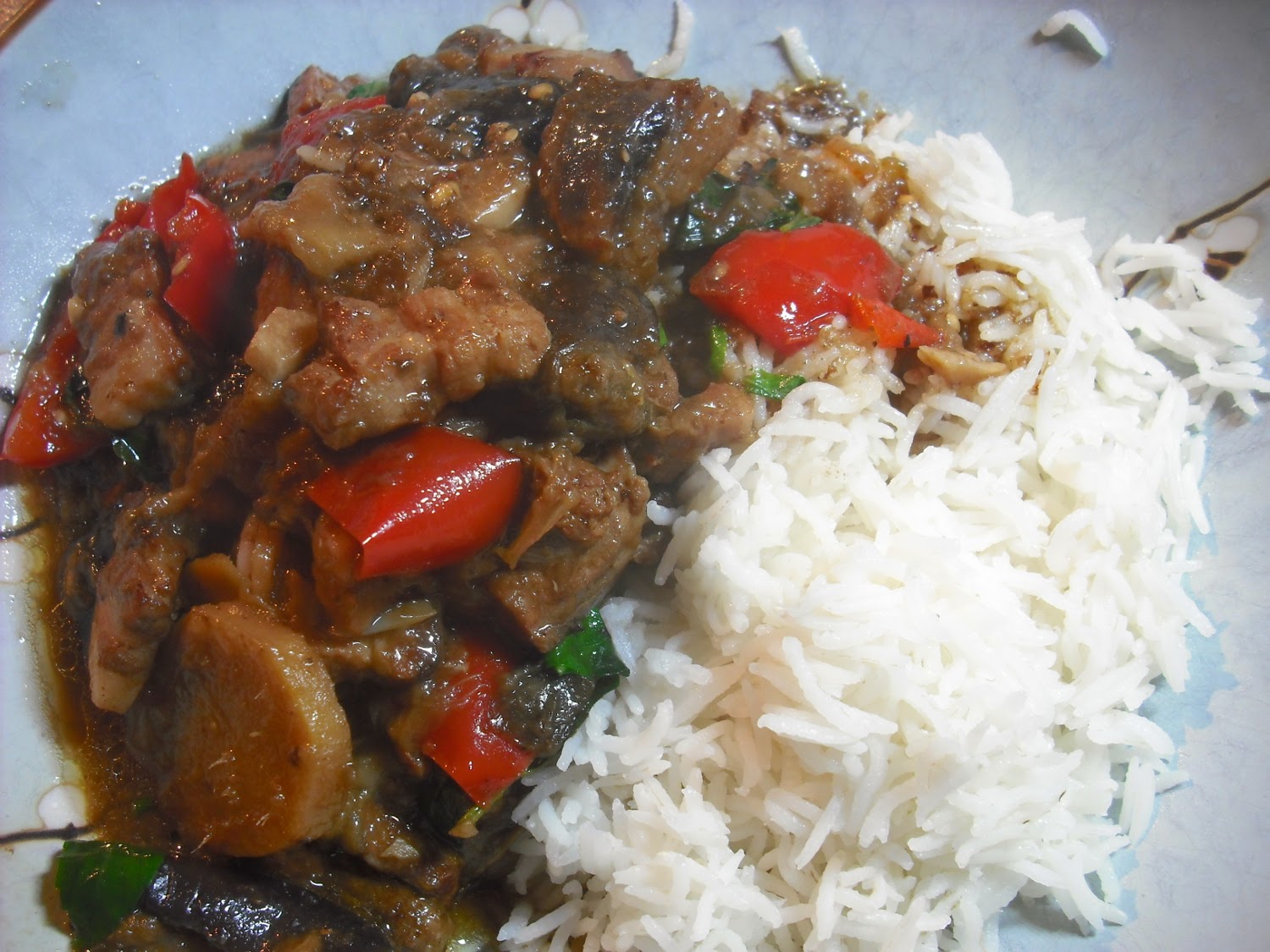
Vaguely Chinese pork & aubergine stew

I started off with the intention of making something like this but ended up making something quite different but equally delicious. It's got some Chinese elements to it but I am not going to claim any sort of authenticity.

I had some not-too-fatty rind-off pork belly slices, which I froze for an hour to make them easy to slice into thin pieces. I browned them thoroughly in a dry pan until the fat started to render out, then added pieces of aubergine and let them brown well. Pieces of ginger, a star anise, garlic, a sliced onion and a chopped red pepper went in as well. Then I deglazed the pan with Shaoxing wine and added a touch of Chinese black vinegar and some light soy sauce, put a lid on and simmered it slowly for about 20 minutes until everything was meltingly tender. I finished it with a lot of freshly ground black pepper and a big bunch of basil leaves. Definitely one to make again.

Friday, 18 October 2013

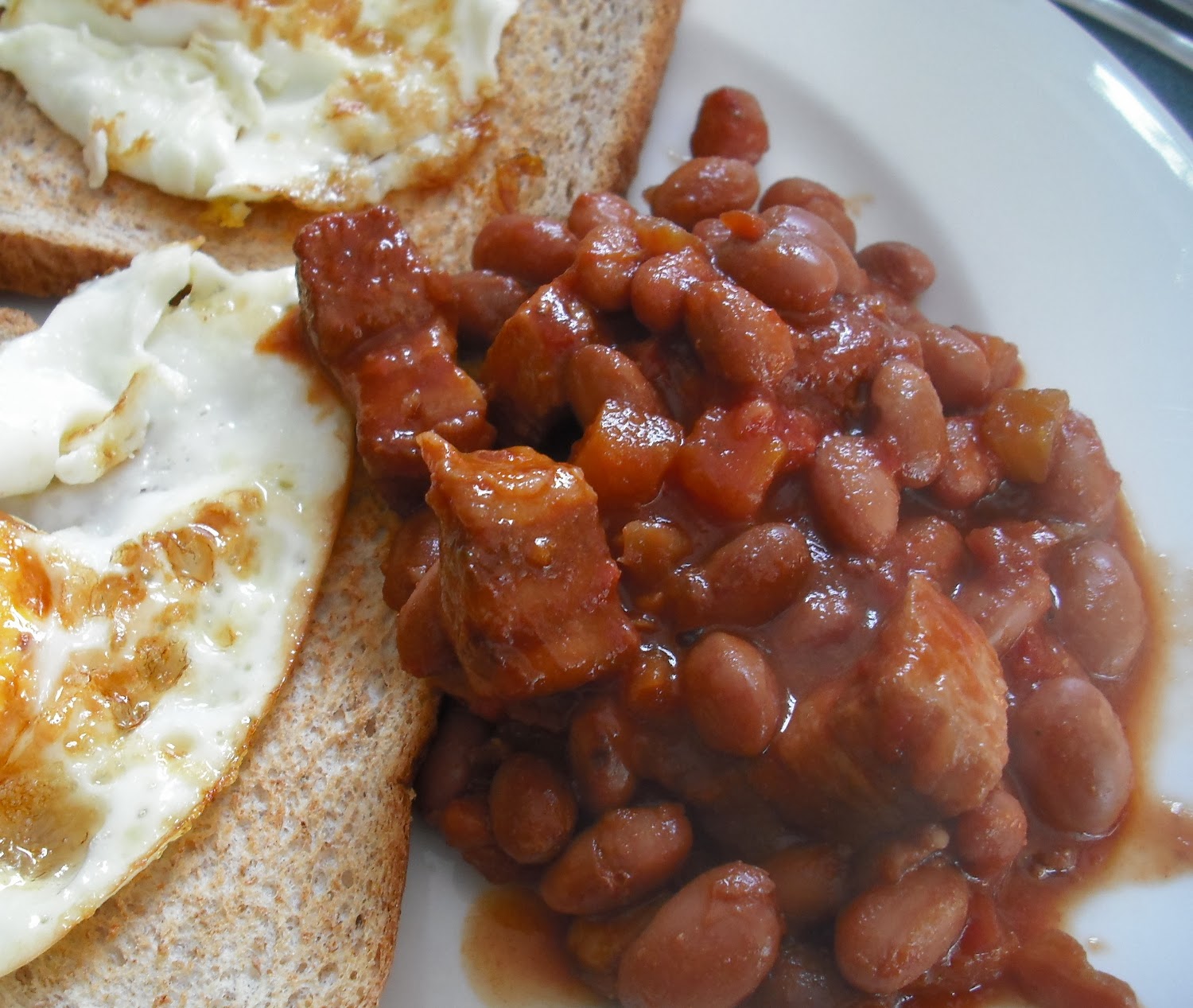
Baked beans

I like tinned baked beans. Not with any sort of passionate fervour, but I like them. A full English breakfast without some bright red (preferably Heinz) beans isn't quite right. Slabs of buttered toast made soggy with hot beans and a shower of grated cheese is a comforting meal when you are feeling a bit pathetic.

These beans owe rather more to the American tradition of baked beans than to the British tinned variety. The ingredients aren't hugely exotic or expensive, but with a bit of time they cook down into something that tastes quite luxurious. And they also have the virtue of getting better with reheating over a couple of days.
I am reducing the amount of salt in my cooking at the moment, so you might want to add more to this. And maybe a splash of red wine vinegar if you really love the tang of the tinned variety.
 
Baked beans

500g pork belly rashers, skin off, cut into 1" cubes
1 small onion, diced
1 carrot, diced
2 sticks of celery, diced
250g borlotti beans (dry weight), soaked overnight and drained
1 can chopped tomatoes
1 vegetable stock cube
1 tsp black treacle or molasses
1 tsp English mustard powder
1 tsp worcestershire sauce
1 whole dried chipotle chilli, slit down the side
1tbs tomato puree

Place the pieces of pork belly fat-side down in a heavy based flameproof casserole dish or dutch oven. Cook over a low heat until the fat starts to render out, then add with onion, carrot and celery and cook until the onion is translucent. Add the beans and tomatoes, fill the tomatoey tin with water to sluice out the juices and add that. Give it a thorough stir to scrape any caught bits of pork off the bottom.

Cover with a lid and bake for an hour at 150C. Remove from the oven, add the rest of the ingredients, plus another can of water if it seems dry.

Bake for another hour, then give it a stir and test a bean for tenderness. If it isn't tender and mealy, repeat the process of adding more water, baking and then testing until they are done. Mine took about 4 hours until I was really happy with them - I think it is because the sauce is so thick it takes longer for them to absorb the liquid than if you just boil them. Of course, if you really don't fancy having the oven on for 4 hours, you can either use tinned beans, or boil the soaked and drained dry beans in plain water for about half an hour, then drain, add to the pork & veg mixture and cook it for about an hour.

So far we've eaten beans with eggs on toast for breakfast, and beans with stilton rarebit for lunch. And we have another portion in the freezer, which may well be served with sausages  or even duck legs for supper.

Sunday, 13 October 2013

Lamb hotpot

The weather is absolutely filthy today. It's raining heavily and there is a distinct chill to the stiff wind. It's time to put away the light salads and grilled meats of summer and get into the stodge.

This is a very simple but warming casserole. It just needs some greens to make a substantial and delicious meal for three: a dinner for the two of us and a frozen portion for a lunch at some point.
Lamb Hotpot (serves 3)

oil
1 onion
1 carrot
2 sticks of celery
3 cloves garlic
6 thick slices scrag end of lamb (about 1kg)
3-4 potatoes
salt, pepper, dried thyme
chicken stock

Pre-heat oven to 160C.

Peel and finely dice the onion and carrot and finely chop the celery. In a flame-proof casserole dish, warm a splash of oil and cook the vegetables until the onion is translucent, then add the sliced garlic.

Place the lamb slices on the vegetables and season with salt, pepper and a sprinkling of thyme, then add a single layer of thickly-sliced potatoes. Pour over chicken stock until it covers the lamb/just comes up to the base of the potatoes.

Cook over a medium heat until the stock starts to bubble, then put the lid on the casserole and bake in the oven for 2 hours. After 1 hour, remove from the oven and baste the potatoes with the stock, then return to the oven. Remove the lid for the last 15 minutes, if the potatoes aren't appetisingly browned.


Saturday, 22 June 2013

Full English bread pudding

This is one of those prepare-ahead dishes that the Americans tend to call casseroles, or strata. But really, it's a bread and butter pudding, made savoury with a layer of all the delicious elements of a full English breakfast. For a brunch or special breakfast where you don't want to be jumping up and down frying eggs for 6 people, make it the night before and refrigerate it. We had it for dinner over a couple of evenings - reheating it didn't totally destroy it, although it was nicer fresh, of course.
It's pretty adaptable, and I have said that the black pudding is optional, but I thought it was the best bit. So maybe this should be the first, non-threatening introduction to black pudding for the squeamish? Anyway, it's delicious and actually demands making in advance, so it needs a bit of pre-planning but once it is in the fridge you can suit yourself when you bake it.
Full English Bread Pudding (serves 6-8 for brunch, 4-6 large appetites for supper)

500g stale bread (I used a poppyseed bloomer)
olive oil
1 medium onion, finely diced
450g pork sausages, removed from their casings and rolled into walnut-size balls
100g bacon, cut into small pieces
200g mushrooms, sliced
2 cloves garlic, chopped
2 spring onions, sliced
1 big handful parsley, finely chopped
150g black pudding, crumbled (optional, but really good)
handful of cherry tomatoes, halved
4 eggs
800ml milk
150g grated cheese (something that melts well. I used gruyere)
Black pepper
Nutmeg (optional - but I am almost incapable of seeing cheese without reaching for nutmeg)

The first bit is the most difficult - figuring out how many slices you need to cut your bread into in order to make two layers of bread slices. That will determine how thickly you need to cut it. Slice the bread and set aside.

Saute the onion in the olive oil until translucent, then add the balls of sausage meat and brown well. Add the bacon, mushrooms and garlic and saute for another few minutes or until the sausage balls are cooked through and the mushrooms have given off some of their liquid and reduced a bit. Stir in the spring onions and parsley, season with black pepper and allow to cool.

Place a layer of bread slices on the bottom of a deep-ish ovenproof dish (I used a pyrex lasagne dish). Spread the cooled mushroom and sausage mixture over the bread, then scatter with the black pudding and cherry tomatoes. Top with the second layer of bread.

Beat the eggs into the milk. If you have some on hand and you are making this for supper, you could add a slosh of vermouth at this point. It's a good addition but I didn't have any. Carefully (because it's going to want to skate off the top of the bread and make a mess) pour the eggy milk all over the bread. It should come up to the top of the sausage mixture.

Sprinkle with grated cheese, a grating more black pepper and a grating of nutmeg. Cover with clingfilm. Now, gently but firmly, press it down with both hands so that the top layer of bread gets pushed down into the custard mixture. Leave in the fridge for a bit - an hour, two hours, overnight, whatever suits you, but it does need a little rest to allow the custard to soak into the bread.

When you are ready to cook it, remove the cling film and bake it at 180 for 45 minutes or until it looks bubbly, golden and set. Serve hot.

Tuesday, 31 January 2012

Oxtail Pörkölt

I've been seeing a lot of goulash recipes around lately. I suppose it is the sort of chilly, damp weather where big pots of slow-cooked meats in richly flavoured sauces are appealing. I was particularly taken by James Ramsden's oxtail goulash recipe. There was just the teensiest problem though. I have a friend of Estonian heritage who has lived in Hungary and has always been quite adamant that what we call goulash is not goulash at all, but porkolt. Porkolt is thicker than the soupier goulash; it's a very simple slow-cooked stew with few ingredients.

Apparently it is quite important to the final flavour to cook the onions initially in lard. I didn't have any lard, so I used some beef dripping left from a rather good roast. The flavour of my porkolt really was exceptionally rich, so I will put that down to the dripping.


The word porkolt apparently means "roasted". The stew gets its character from the meat being well-browned in the onions and paprika before liquid is added.


My apologies to your Hungarian grandmother if this isn't how she did it. It tasted good and it had a very old-fashioned sort of flavour, so I am hoping it isn't too desperately inauthentic.

Oxtail Porkolt (makes about 3 portions)

2 tbs lard or beef dripping (or oil)
3 large onions, finely sliced
2 cloves of garlic, sliced
1 kg oxtail
2 tbs sweet paprika
1 tbs hot smoked paprika
1-2 red peppers, diced (I only had one but 2 would have been better)
1 can chopped tomatoes
500ml beef stock

Melt the beef dripping in a large oven-proof saucepan or casserole (I used my Le Creuset dutch oven, of course), then add the onions and cook gently until translucent. Increase the heat and add the garlic and the pieces of oxtail. When the oxtail starts to take colour, sprinkle over both paprikas and cook until the meat starts to get bit of a crust on it from the paprika. Add the diced peppers, tomatoes and beef stock, stirring well to scrape up the toasty bits from the bottom of the casserole. Bring to the boil, then put the lid on and cook in a low oven for about 4 hours, having a look about once an hour to make sure it isn't getting dry.

For about the last half hour, if there is still a lot of sauce, you might want to take the lid off to let it reduce to a really thick gravy.

Serve with buttered noodles or spatzle.

There was a little bit of intensely-flavoured, jellied sauce and a couple of bits of meat left after we'd stuffed ourselves silly, so I used it to fill some rounds of pastry for little fried empanadas for lunch.


Thursday, 25 February 2010

A short season of Delia Smith

Recently on BBC iplayer we've been watching Delia Through The Decades - a retrospective of Delia Smith's career in TV cookery. It inspired me to dig out my Delia Smith cookbooks and see how the recipes have stood the test of time. It's been cold and wet, with slushy snow and sleet for the last couple of weeks, so I gravitated to the Winter Collection and particularly the chapter on casseroles! I bought a Casserole Box from the Well Hung Meat Company and set about converting the meat into delicious meals - so my recipe selection was partly dictated by the cuts in the box.

First up was the pork stroganoff with three kinds of mustard, using the diced pork. Instead of grainy mustard I used some fancyschmance sun-dried tomato mustard that I got in a Christmas hamper. I also subbed buttermilk for the creme fraiche because it is a third of the price, and added some dried porcini mushrooms because they are delicious. Sadly, this is a very beige plate, because when I cut into the red cabbage that I intended to braise, I discovered that it was in fact a green cabbage with red outer leaves. So I stirfried the shredded cababge with onions and apples and seasoned it with nutmeg. So aesthetically speaking this is a fail, but for flavour a definite win.

Then came Braised Steak au Poivre - a slow-cooked variation on a French pepper steak. My only real variation in this one was to use a mixture of black and fresh green peppercorns. Again, it won't win any beauty contests - although serving it with gratin dauphinoise made things worse - but the flavour was excellent. The braising steak became tender and even though there is only a small amount of cream in it, it tasted very rich and decadent.

With the diced beef from the casserole box, I made Black Bean Chilli with Avocado Salsa. This was the only one of the recipes I'd made before, so I knew it was good. Unfortunately the supermarket substituted a small can of red kidney beans for my 500g bag of dried black turtle beans, so the chilli wasn't as beany as I like and didn't have the luscious purple colour that the black beans give. But the flavour was excellent and the fresh, cool salsa is such a nice contrast in temperature and texture.

Lastly, the lamb neck fillet was crying out to become Irish Stew with Crusted Dumplings. I only used neck fillets, rather than a mixture of fillets and cutlets, and I cheated and bought suet dumplings - I can get suet dumplings from supermarket for less than the ingredients to make them. So because my dumplings didn't have parsley in them, I added some dried thyme to the seasoned flour. I made this on Tuesday night, while my spaghetti sauce was simmering for that night's dinner, then added the dumplings and finished it off in the oven last night, so even though it has a long cooking time, it wasn't at all arduous. This one will definitely be made again - somehow I hadn't realised that lamb and barley and dumplings are three of Paul's favourite foods, and together they had him in raptures.

I'm now inspired to go through more of my cookbooks, to see what treasures I have missed, or forgotten!


Monday, 25 August 2008

Cassoulet

OK, that's it for holiday posting, now we can resume regular programming.

Last night it was time to have some proper home cooking again. We'd had home cooking the night before, but in someone else's home so it doesn't really count (blackberry pie, thanks Molly!).

The problem was, of course, that we cleared the fridge before we went away and haven't been shopping except for milk and beer since.

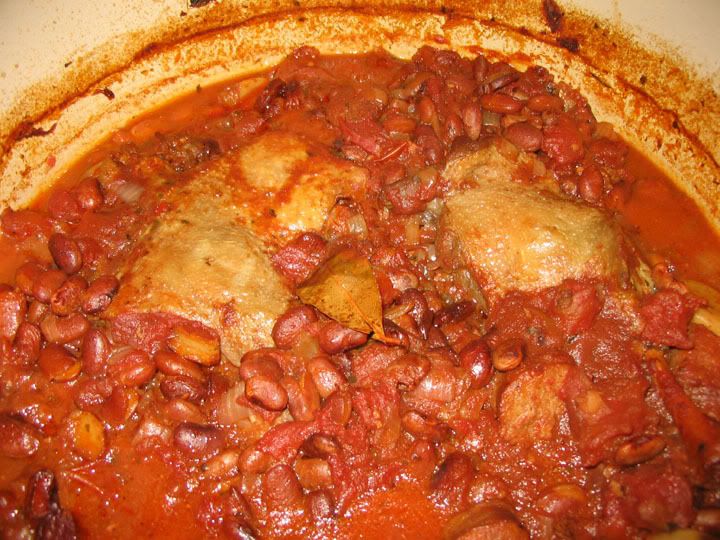
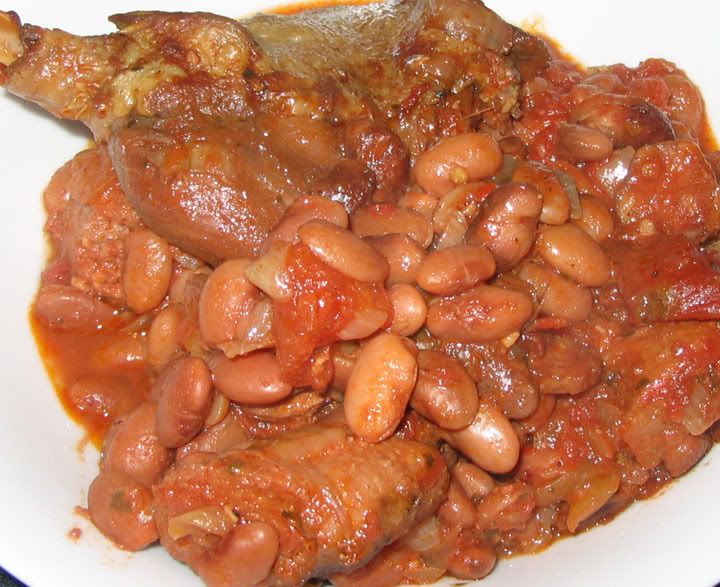
I took an inventory of the pantry and freezer and came up with cassoulet - a bag of pinto beans, soaked until I got bored, an onion, loads of garlic, a couple of pork sausages, a couple of duck legs confit, a couple of tins of chopped tomatoes, some duck stock and a bunch of dried herbs and whatnot. I went a bit crazy adding a couple of lup cheong and some smoked paprika, but I wanted it really flavourful and gutsy. On the stove until it bubbled and then into a very slow oven for about 5 hours. It did the job of being hearty and comforting (cruddy weather we are having!) and delaying the day that we really, really have to go to the supermarket.

Saturday, 19 April 2008

Braised Venison Shanks

I took a half day from work yesterday and went to Borough Market yesterday - hence the black pudding with breakfast this morning. While the vegetable, flower and cheese stalls at Borough are always gorgeous (I was sorely tempted by some massive globe artichokes and an amazing gooey brie) my problem is then how to transport my booty home. Meat just travels better! So I end up buying loads of different types of flesh. This time I bought (in addition to the black pudding) some bratwurst - probably dinner tomorrow, with some sauerkraut, a rolled shoulder of heather-grazed Orkney lamb and a couple of fallow venison shanks.

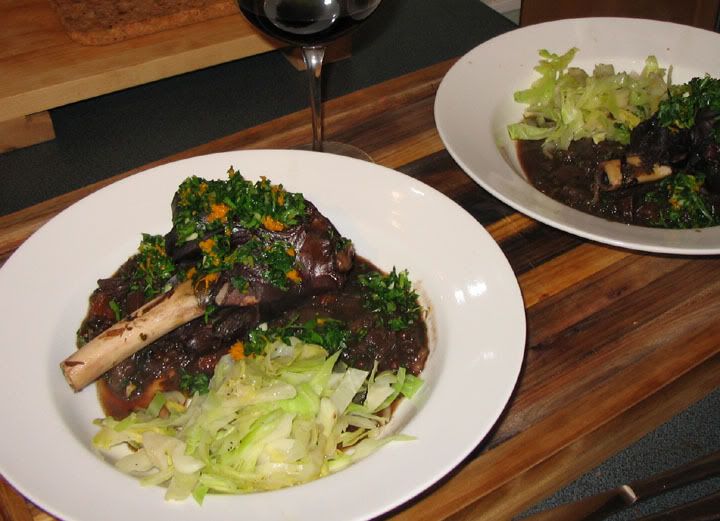
The weather today has been filthy - cold and blustery and rainy - so a casserole of the shanks was most definitely in order. I've been hankering for osso bucco, but my husband isn't a fan, so I figured I would apply the best part of osso bucco, the gremolata, to my shanks. In addition, at the Market I'd tried a balsamic syrup flavoured with orange, and my friend Kim had pointed out how lovely it would be with venison. So I decided that some of the marmalade backlog would go into the sauce and that the gremolata would be orange zest, not lemon. So here we have it:

Braised venison shanks with gremolata

2 venison shanks
1tbs oil
1 onion
6 cloves of garlic, peeled
selection of winter veg (I used an M&S concoction of more onion, carrot, cabbage, swede, leek, potato and lentils)
½ bottle red wine
500ml chicken stock
1 bay leaf
5 juniper berries, crushed
2 tsp bitter orange marmalade
salt & pepper

For the gremolata

2 more garlic cloves
bunch flat-leaf parsley
grated rind of a large orange

Brown the venison shanks in the oil on all sides in a heavy, lidded casserole or saucepan (I used a le Creuset dutch oven), with the whole cloves of garlic. Add the onion, diced, and stir around until the onion begins to soften. Add the cubed veg, wine, stock, bay leaf and juniper berries and bring to the boil. Put the lid on and turn the heat down to a simmer. If your pot fits in the oven (mine doesn’t), you can put it in a 150C oven. Cook gently for about 3 – 31/2 hours, until the meat is falling off the bone.

Combine the extra garlic cloves, the finely chopped parsley and the grated orange rind.

Remove the shanks from the pot, put in a bowl and pour a couple of spoons of the cooking broth over, and put in a low oven to keep warm. Increase the heat under the pot, so that the sauce reduces. Add the marmalade and half the gremolata and season to taste. Cook for another couple of minutes to soften the parsley. There should still be a bit of liquid around the vegetables but not too much.

Divide the sauce between deep serving plates and top with a shank each. Sprinkle with the remaining gremolata and serve with a simple green vegetable.


LinkWithin

Related Posts Plugin for WordPress, Blogger...