Potatoes and cabbage. Just the words sound stodgy, bland, fart-inducing and lowering to the spirits. This is, however, a remarkably light and delicious dish from the same school of veg cooking that brought you this and this. You stick vegetables in tasty liquor and eat them when they are done. This features my current obsession, fennel seeds, but if you can stomach horrible caraway, that would work too. I think. Too dreadful to contemplate but some people seem to like them.
Potatoes and cabbage (serves 2 - 3 as a side dish)
Knob of butter
1 onion, sliced (clearly I used a red onion, which is pretty but not important)
1/2 tsp fennel seeds
3 large potatoes, peeled, cut into chunks and parboiled until just tender
100ml vermouth
1/2 green/savoy cabbage, sliced
3-4 artichoke hearts, cut into quarters (I used marinated ones, but regular tinned ones would be just fine)
Salt, pepper, juice of half a lemon
Melt the butter in a saute pan and add the onions and fennel seeds. Saute until the fennel is fragrant and the onion is floppy, then add the parboiled potatoes and vermouth. Cook gently for 3-4 minutes, then add the cabbage. If it is looking dry, add a splash of water. Simmer until the cabbage wilts, then add the artichoke hearts. Cook another couple of minutes until the artichokes are hot through, correct the seasoning with salt, pepper and lemon juice. There should be just enough liquid left to make a small sauce.
We had this with salmon, and a roux-based caper and parsley sauce, but it would also go well with pork. With chunks of smoked cheese tossed through at the last minute it would make a very good meal.
Sunday, 20 October 2013
Friday, 18 October 2013
Baked beans
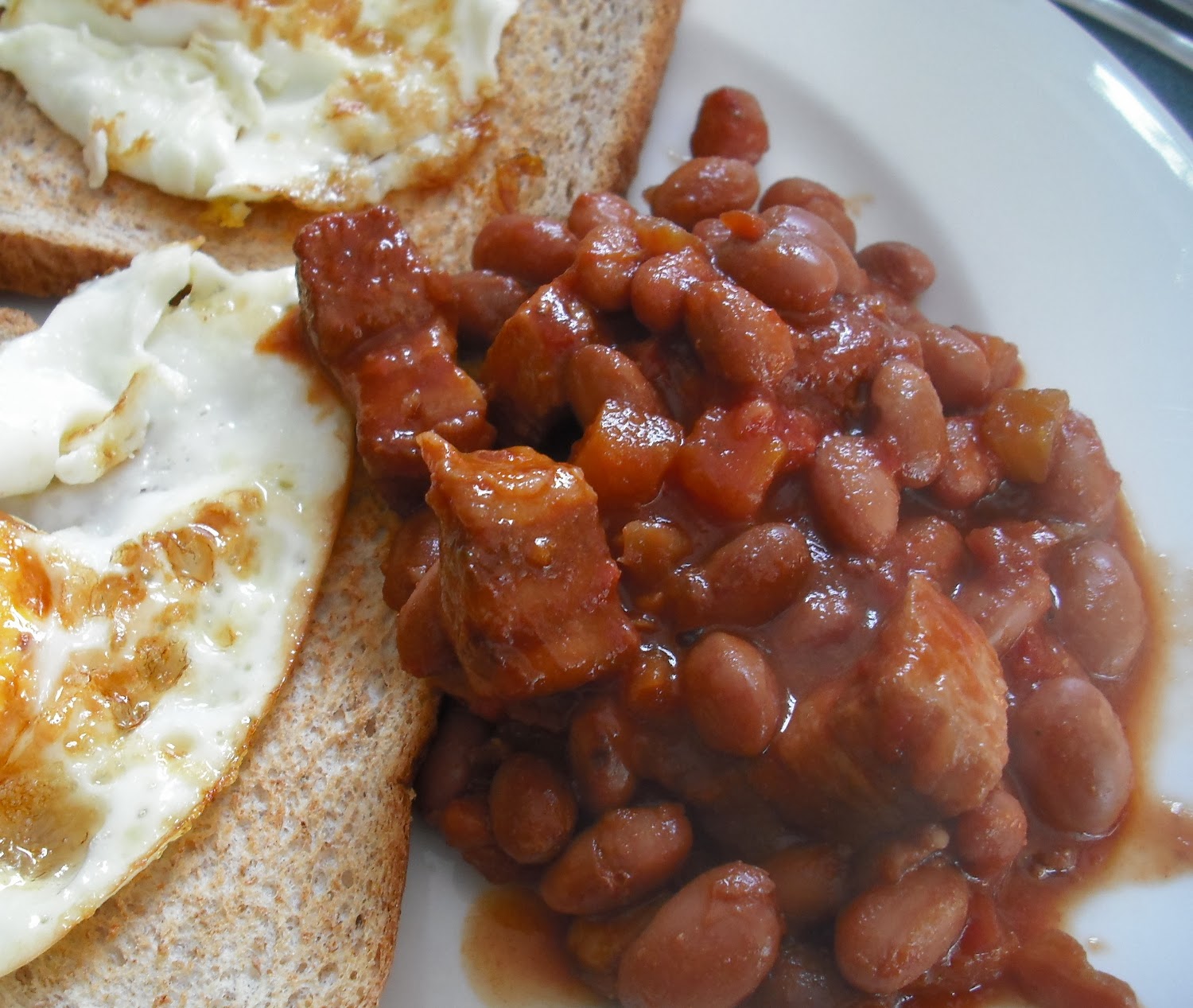
I like tinned baked beans. Not with any sort of passionate fervour, but I like them. A full English breakfast without some bright red (preferably Heinz) beans isn't quite right. Slabs of buttered toast made soggy with hot beans and a shower of grated cheese is a comforting meal when you are feeling a bit pathetic.
These beans owe rather more to the American tradition of baked beans than to the British tinned variety. The ingredients aren't hugely exotic or expensive, but with a bit of time they cook down into something that tastes quite luxurious. And they also have the virtue of getting better with reheating over a couple of days.
I am reducing the amount of salt in my cooking at the moment, so you might want to add more to this. And maybe a splash of red wine vinegar if you really love the tang of the tinned variety.
Baked beans
500g pork belly rashers, skin off, cut into 1" cubes
1 small onion, diced
1 carrot, diced
2 sticks of celery, diced
250g borlotti beans (dry weight), soaked overnight and drained
1 can chopped tomatoes
1 vegetable stock cube
1 tsp black treacle or molasses
1 tsp English mustard powder
1 tsp worcestershire sauce
1 whole dried chipotle chilli, slit down the side
1tbs tomato puree
Place the pieces of pork belly fat-side down in a heavy based flameproof casserole dish or dutch oven. Cook over a low heat until the fat starts to render out, then add with onion, carrot and celery and cook until the onion is translucent. Add the beans and tomatoes, fill the tomatoey tin with water to sluice out the juices and add that. Give it a thorough stir to scrape any caught bits of pork off the bottom.
Cover with a lid and bake for an hour at 150C. Remove from the oven, add the rest of the ingredients, plus another can of water if it seems dry.
Bake for another hour, then give it a stir and test a bean for tenderness. If it isn't tender and mealy, repeat the process of adding more water, baking and then testing until they are done. Mine took about 4 hours until I was really happy with them - I think it is because the sauce is so thick it takes longer for them to absorb the liquid than if you just boil them. Of course, if you really don't fancy having the oven on for 4 hours, you can either use tinned beans, or boil the soaked and drained dry beans in plain water for about half an hour, then drain, add to the pork & veg mixture and cook it for about an hour.
So far we've eaten beans with eggs on toast for breakfast, and beans with stilton rarebit for lunch. And we have another portion in the freezer, which may well be served with sausages or even duck legs for supper.
These beans owe rather more to the American tradition of baked beans than to the British tinned variety. The ingredients aren't hugely exotic or expensive, but with a bit of time they cook down into something that tastes quite luxurious. And they also have the virtue of getting better with reheating over a couple of days.
I am reducing the amount of salt in my cooking at the moment, so you might want to add more to this. And maybe a splash of red wine vinegar if you really love the tang of the tinned variety.
Baked beans
500g pork belly rashers, skin off, cut into 1" cubes
1 small onion, diced
1 carrot, diced
2 sticks of celery, diced
250g borlotti beans (dry weight), soaked overnight and drained
1 can chopped tomatoes
1 vegetable stock cube
1 tsp black treacle or molasses
1 tsp English mustard powder
1 tsp worcestershire sauce
1 whole dried chipotle chilli, slit down the side
1tbs tomato puree
Place the pieces of pork belly fat-side down in a heavy based flameproof casserole dish or dutch oven. Cook over a low heat until the fat starts to render out, then add with onion, carrot and celery and cook until the onion is translucent. Add the beans and tomatoes, fill the tomatoey tin with water to sluice out the juices and add that. Give it a thorough stir to scrape any caught bits of pork off the bottom.
Cover with a lid and bake for an hour at 150C. Remove from the oven, add the rest of the ingredients, plus another can of water if it seems dry.
Bake for another hour, then give it a stir and test a bean for tenderness. If it isn't tender and mealy, repeat the process of adding more water, baking and then testing until they are done. Mine took about 4 hours until I was really happy with them - I think it is because the sauce is so thick it takes longer for them to absorb the liquid than if you just boil them. Of course, if you really don't fancy having the oven on for 4 hours, you can either use tinned beans, or boil the soaked and drained dry beans in plain water for about half an hour, then drain, add to the pork & veg mixture and cook it for about an hour.
So far we've eaten beans with eggs on toast for breakfast, and beans with stilton rarebit for lunch. And we have another portion in the freezer, which may well be served with sausages or even duck legs for supper.
Tuesday, 15 October 2013
The Bluffin Loaf
Last week's Big Food Story was that Starbucks launched a new bakery item, a doughnut/muffin hybrid they were calling the "duffin". Only problem is that Bea's of Bloomsbury have been selling duffins for almost three years. Starbuck's described their duffins as "filled with a raspberry jam; we’ve added just a hint of nutmeg to our buttermilk base and then covered it in sugar once baked". Bea's ingredients include nutmeg, buttermilk and raspberry jam - she published the recipe in her cookbook in 2011. Even that seemingly-blatant appropriation wouldn't have been a big deal necessarily, except the factory who supplies Starbucks trademarked the name, claiming they couldn't find a prior use.
The outcry was swift and loud. It got a lot of media coverage (each of those is a separate link). Starbucks adopted the position that they never said Bea's would have to stop using the name. Which I suspect means that they just hadn't got around to sending her the cease-and-desist letter yet, because they definitely have form for going after the little guys. And anyway, why would you register a trademark if you had no intention of protecting it?
So Starbucks manages to look even worse than usual and Bea looks like a plucky but modest hero for standing her ground and wanting the name duffin to be available for use by everyone.
I don't patronise Starbucks, making a boycott from me a bit of an empty threat, but I was pretty keen to be on the side of the angels for this one. I popped into Bea's on Thursday to buy a couple of the controversial cakes. I was actually a bit surprised they had any left, but the young woman who served me said they were on their third bake for the day because they are so hot right now. And I tell you what, they are absolutely delicious. The subtle hint of nutmeg and crunchy sugar coating makes them taste doughnutty, but the texture is like the lightest, moistest muffin and the raspberry jam gives a good tang.
So over the weekend when I felt like baking, Bea's duffins came to mind. I don't actually have her cookbook, but I do have Nigella Lawson's How to be a domestic goddess, containing a doughnut muffin recipe. I read Nigella's recipe and was unsatisfied by the lack of buttermilk and nutmeg. I flicked through the rest of the book and saw Nigella's blueberry buttermilk muffin recipe.
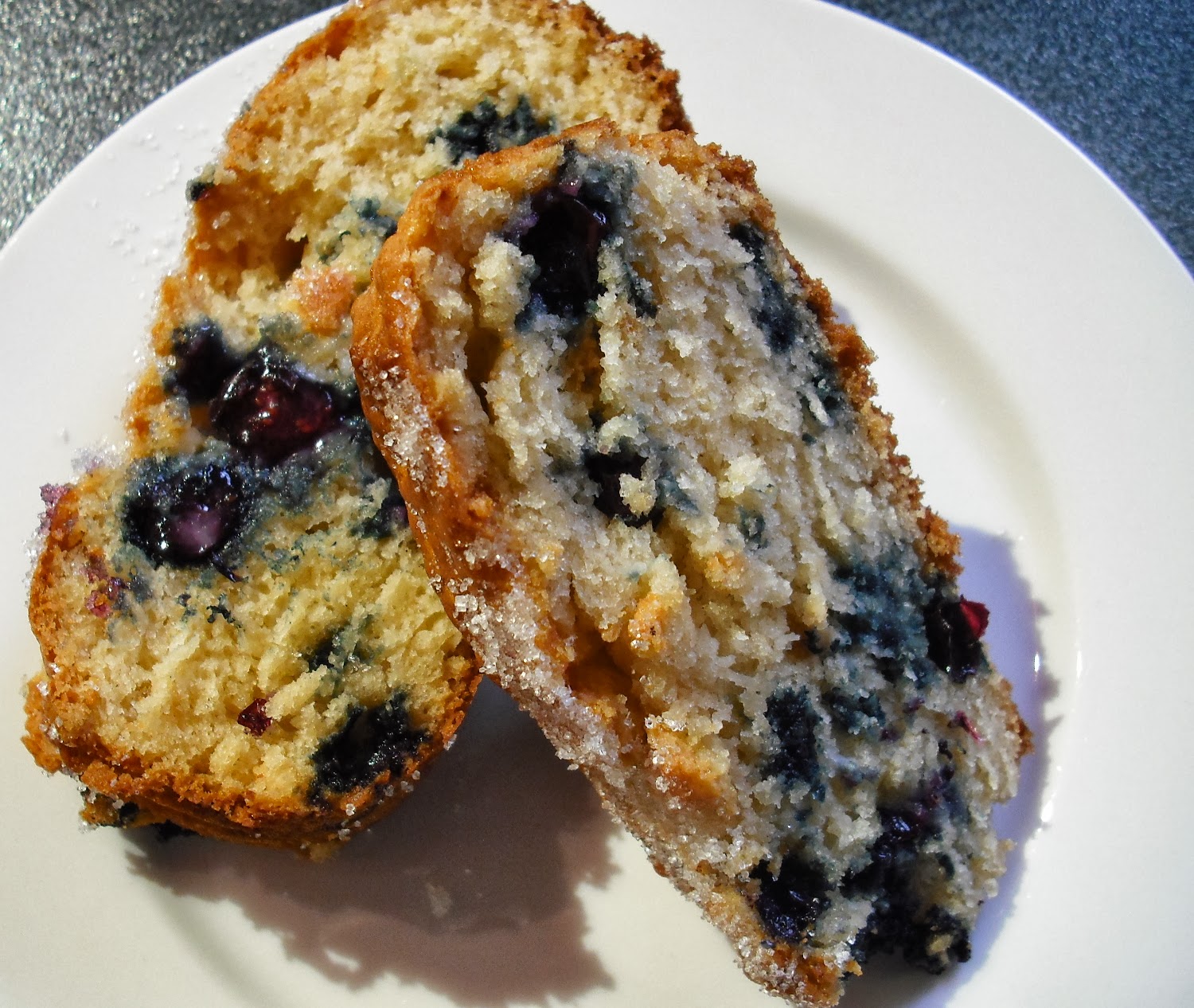
Conveniently, I had a punnet of blueberries. I stuck the two recipes together, reducing the raising agents, adding a good grating of nutmeg, and baking it in a loaf tin and created... The Bluffin Loaf. Which was a great success, although I could have been more heavy-handed with the nutmeg. I will not be attempting to register the trademark.
The outcry was swift and loud. It got a lot of media coverage (each of those is a separate link). Starbucks adopted the position that they never said Bea's would have to stop using the name. Which I suspect means that they just hadn't got around to sending her the cease-and-desist letter yet, because they definitely have form for going after the little guys. And anyway, why would you register a trademark if you had no intention of protecting it?
So Starbucks manages to look even worse than usual and Bea looks like a plucky but modest hero for standing her ground and wanting the name duffin to be available for use by everyone.
I don't patronise Starbucks, making a boycott from me a bit of an empty threat, but I was pretty keen to be on the side of the angels for this one. I popped into Bea's on Thursday to buy a couple of the controversial cakes. I was actually a bit surprised they had any left, but the young woman who served me said they were on their third bake for the day because they are so hot right now. And I tell you what, they are absolutely delicious. The subtle hint of nutmeg and crunchy sugar coating makes them taste doughnutty, but the texture is like the lightest, moistest muffin and the raspberry jam gives a good tang.
So over the weekend when I felt like baking, Bea's duffins came to mind. I don't actually have her cookbook, but I do have Nigella Lawson's How to be a domestic goddess, containing a doughnut muffin recipe. I read Nigella's recipe and was unsatisfied by the lack of buttermilk and nutmeg. I flicked through the rest of the book and saw Nigella's blueberry buttermilk muffin recipe.
Conveniently, I had a punnet of blueberries. I stuck the two recipes together, reducing the raising agents, adding a good grating of nutmeg, and baking it in a loaf tin and created... The Bluffin Loaf. Which was a great success, although I could have been more heavy-handed with the nutmeg. I will not be attempting to register the trademark.
Sunday, 13 October 2013
Lamb hotpot
The weather is absolutely filthy today. It's raining heavily and there is a distinct chill to the stiff wind. It's time to put away the light salads and grilled meats of summer and get into the stodge.
This is a very simple but warming casserole. It just needs some greens to make a substantial and delicious meal for three: a dinner for the two of us and a frozen portion for a lunch at some point.
Lamb Hotpot (serves 3)
oil
1 onion
1 carrot
2 sticks of celery
3 cloves garlic
6 thick slices scrag end of lamb (about 1kg)
3-4 potatoes
salt, pepper, dried thyme
chicken stock
Pre-heat oven to 160C.
Peel and finely dice the onion and carrot and finely chop the celery. In a flame-proof casserole dish, warm a splash of oil and cook the vegetables until the onion is translucent, then add the sliced garlic.
Place the lamb slices on the vegetables and season with salt, pepper and a sprinkling of thyme, then add a single layer of thickly-sliced potatoes. Pour over chicken stock until it covers the lamb/just comes up to the base of the potatoes.
Cook over a medium heat until the stock starts to bubble, then put the lid on the casserole and bake in the oven for 2 hours. After 1 hour, remove from the oven and baste the potatoes with the stock, then return to the oven. Remove the lid for the last 15 minutes, if the potatoes aren't appetisingly browned.
This is a very simple but warming casserole. It just needs some greens to make a substantial and delicious meal for three: a dinner for the two of us and a frozen portion for a lunch at some point.
Lamb Hotpot (serves 3)
oil
1 onion
1 carrot
2 sticks of celery
3 cloves garlic
6 thick slices scrag end of lamb (about 1kg)
3-4 potatoes
salt, pepper, dried thyme
chicken stock
Pre-heat oven to 160C.
Peel and finely dice the onion and carrot and finely chop the celery. In a flame-proof casserole dish, warm a splash of oil and cook the vegetables until the onion is translucent, then add the sliced garlic.
Place the lamb slices on the vegetables and season with salt, pepper and a sprinkling of thyme, then add a single layer of thickly-sliced potatoes. Pour over chicken stock until it covers the lamb/just comes up to the base of the potatoes.
Cook over a medium heat until the stock starts to bubble, then put the lid on the casserole and bake in the oven for 2 hours. After 1 hour, remove from the oven and baste the potatoes with the stock, then return to the oven. Remove the lid for the last 15 minutes, if the potatoes aren't appetisingly browned.
Sunday, 6 October 2013
A slightly pallid plateful
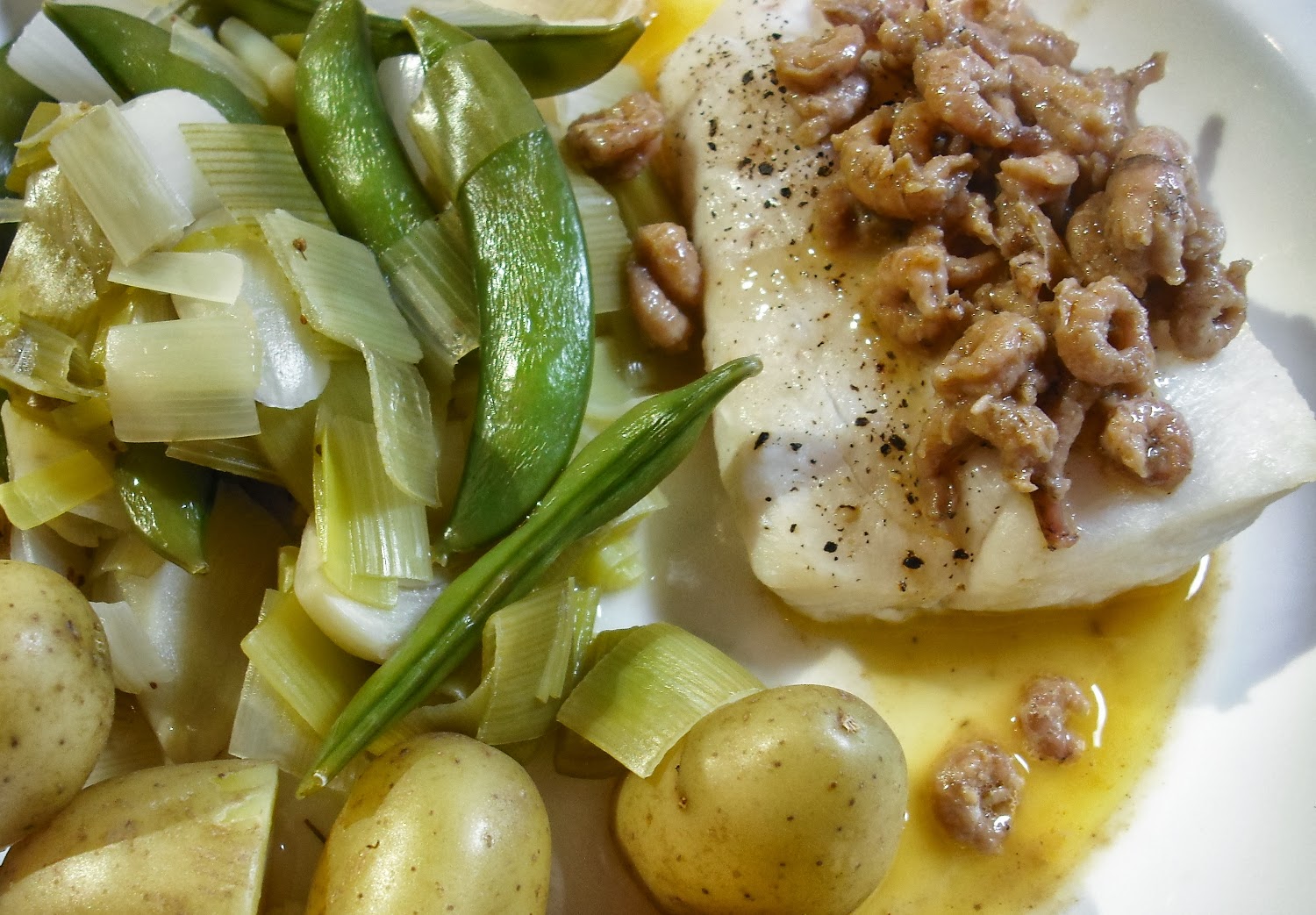
This dinner was all about delicate flavours and colours. Subtleties. Not something I do all that often, but it's nice to mix things up!
Because I wanted to top the fish with melted potted shrimp (i.e lots of delicious salty butter) I didn't want to add any other fat. The vegetables were all poached in a court bouillon while the cod loins baked in the oven on a piece of baking parchment. Then I just heated the shrimp until the butter bubbled and poured it on top.
Poached vegetables (serves 2)
6-8 new potatoes, scrubbed (any larger ones cut in half)
2 cloves garlic, sliced
3 medium sized leeks, thoroughly cleaned and cut into 1cm half-moons
200g sugar snap peas
1 tsp fennel seeds
1/2 tsp coriander seeds
1/2 tsp black peppercorns
Juice of 1 lemon
Put the potatoes, garlic, fennel seeds, coriander seeds and peppercorns in a saute pan and half cover with boiling water. Simmer about 5 minutes, uncovered, then turn the potatoes and cook for another 5 minutes. Add the leeks, sugar snap peas and lemon juice and cook for another couple of minutes until all the veg is tender. Serve with a slotted spoon so that most of the liquid drains off but there is still a little bit to keep things moist.
Because I wanted to top the fish with melted potted shrimp (i.e lots of delicious salty butter) I didn't want to add any other fat. The vegetables were all poached in a court bouillon while the cod loins baked in the oven on a piece of baking parchment. Then I just heated the shrimp until the butter bubbled and poured it on top.
Poached vegetables (serves 2)
6-8 new potatoes, scrubbed (any larger ones cut in half)
2 cloves garlic, sliced
3 medium sized leeks, thoroughly cleaned and cut into 1cm half-moons
200g sugar snap peas
1 tsp fennel seeds
1/2 tsp coriander seeds
1/2 tsp black peppercorns
Juice of 1 lemon
Put the potatoes, garlic, fennel seeds, coriander seeds and peppercorns in a saute pan and half cover with boiling water. Simmer about 5 minutes, uncovered, then turn the potatoes and cook for another 5 minutes. Add the leeks, sugar snap peas and lemon juice and cook for another couple of minutes until all the veg is tender. Serve with a slotted spoon so that most of the liquid drains off but there is still a little bit to keep things moist.
Friday, 4 October 2013
Merchant's Tavern
Living in the farthest reaches of what can reasonably be considered London, as we do, we miss out on quite a bit of Londony stuff. We don't tend to get to gallery openings or hot new bars and by the time we've decided to go to a pop-up, it's over. Twitter is changing that a bit. I'm now actually finding out about events in time to do something about them.
I'd seen reports that Angela Hartnett and Neil Borthwick were opening a restaurant. Then @thomasblythe tweeted the details of the soft launch, so I threw my hat in the ring for a booking and was rewarded with a 6pm table, with 50% off the food bill. Which was fine by me. Again, living in the farthest reaches of what can reasonably be considered London, an early dinner means not having to hurtle for the last train.
It's a lovely room. A Victorian warehouse, apparently, so it is open and airy, with a long skylight adding to the open feeling. The tables have a reasonable amount of elbow room around them, which is nice. I hate fearing that I am going to sit in someone's bread and butter when I squeeze between tables to get to the loo. It also meant that we weren't inadvertent participants in other people's conversations. One of the extremely friendly staff told us that all the banquettes etc are moveable, so the room can be reconfigured for different events. Very clever design.
The thing about a soft launch, of course, is that there may be bugs and hitches that are being ironed out. There was nothing too dramatic, the staff seemed more worried and anxious about them than we were: the room was quite smoky when we arrived due to the Big Green Egg, our first choice of wine was unavailable, and having told us that there were no changes to the menu the waiter had to confess that the halibut was going to be cod. Not exactly evening-ruining events, and in a lot of restaurants those things don't even get identified as hassles.
Paul had a pint of Camden Pale Ale and I had a glass of crémant de Loire while we ordered, then we shared a bottle of verdejo from the very reasonably-priced wine list. The wine was kept in an ice bucket at a station in the middle of the room, so we were at the mercy of the staff noticing when our glasses were empty, but fortunately they appreciated that a woman is not a camel and kept me well topped up.
| Angela Hartnett and the other chefs in action |
I can't remember the last time I was tempted by quail on a menu. So many bones, so little meat, always so sticky with sugary sauces. And yet roast quail, remoulade, hazelnut pesto and foie gras called my name. The way it was presented, as a wee confit leg and a plump roasted breast meant few bones and a satisfying quantity of meat. The foie gras was the sweetest thing on the plate, everything else had a finely judged bitterness or robust savoury flavour. The very delicate slivers of celeriac remoulade bounced their nuttiness off the hazelnut pesto and smoothed out the bitter radicchio, then the radicchio cut through the jellied fatty sweetness of the foie gras. Such a lovely autumnal dish.
Our main courses were quite similar in presentation, but not in flavour. Paul had roast brill with coco beans, anchovies and bread sauce. I first tried coco beans at Le Manoir in 2007 and I'd thought they were beautiful, so it's lovely to see them becoming more popular. Their creamy blandness was the perfect accompaniment to the nutmeggy bread sauce, beautifully cooked fish, salty spears of samphire and heady rosemary and anchovy flavours.
The thing that drew me to the halibut (or, in fact, cod), ham hock, chicken broth, leeks and salsify was the salsify. I've cooked it a couple of times and found it delicious but a soul-destroying fiddle to prepare, so having it cooked for me seemed like a very good idea. It's known as the "oyster plant" but to me it tastes like the best bit of an artichoke heart. It complemented the moist, flaky fish, shreds of ham and leeks beautifully. The chicken broth was very intense and just faintly too salty. When I had a spoonful with some of the fish it was fine, but sipped by itself it was overwhelming. So I had to sop up the remaining broth with some of the excellent sourdough bread.
I think both mains would have benefitted from some vegetables on the side, but we weren't offered any and they didn't feature on the menu. I also have a suspicion that some punters might fret at the lack of spuds. Not that I would have wanted chips with this but you know how some people get with insufficient carbs.
The relatively light main courses meant that I had plenty of space for pudding. Which led to the revelation that my husband has a pathological hatred for the name "rum baba". He claims that there was something on TV where they talked about rum babas and they said it so often over so many weeks that he now can't hear the words without flying into a rage. Weird. But that didn't stop me from ordering it.
The rum baba itself was wonderful; light and totally sodden with powerfully alcoholic syrup. The accompanying apples and raisins were a bit less successful. The slices of raw green apple (thankfully not called a carpaccio) didn't really seem to belong, there wasn't really anything sweet or rich enough to need that extra sharp bite. The golden raisins had been plumped up in something with a bit of zingy citrus zest but weren't quite plump or tender enough and the caramelised apples were a bit meagre. I think swapping the raw apple for a couple more wedges of caramelised apple would be more successful. I am now considering making something similar as our Christmas dessert, although I won't be able to call it a rum baba.
Tuesday, 1 October 2013
Pear Parkin
I'm feeling slightly bereft this week. After 8 years, Dan Lepard has left The Guardian and I am not entirely sure what I shall do without him. I decided to bake something to mark the occasion.
The summer that has produced so many grapes for us has also produced a lot of pears, so I wanted to use some before the birds got them all. And the obvious partner for pears is ginger.
I made Dan's 100 year old parkin recipe, using the zest of a lime instead of half a lemon, and substituted chopped crystallised ginger (made from Dan's recipe) for the mixed peel. The other change I made was to lighten it up a bit, using white sugar instead of light brown and reversing the quantities for the treacle and golden syrup.
Then I simply spread the mixture over peeled, cored and quartered pears in a cake tin. The batter is thick and sticky, so it didn't spread easily, and it didn't actually cover the pears completely. I just trusted to the quantities of butter and sugars to make it all spread out in the oven.
Which it did. The batter expanded into all the gaps like that space invading foam stuff. But spicier. The cake itself is slightly chewy and pairs very nicely with the sweet, juicy but not strongly flavoured pears. It's a lovely taste of early autumn and a fitting tribute to Dan's columns.
The summer that has produced so many grapes for us has also produced a lot of pears, so I wanted to use some before the birds got them all. And the obvious partner for pears is ginger.
I made Dan's 100 year old parkin recipe, using the zest of a lime instead of half a lemon, and substituted chopped crystallised ginger (made from Dan's recipe) for the mixed peel. The other change I made was to lighten it up a bit, using white sugar instead of light brown and reversing the quantities for the treacle and golden syrup.
Then I simply spread the mixture over peeled, cored and quartered pears in a cake tin. The batter is thick and sticky, so it didn't spread easily, and it didn't actually cover the pears completely. I just trusted to the quantities of butter and sugars to make it all spread out in the oven.
Which it did. The batter expanded into all the gaps like that space invading foam stuff. But spicier. The cake itself is slightly chewy and pairs very nicely with the sweet, juicy but not strongly flavoured pears. It's a lovely taste of early autumn and a fitting tribute to Dan's columns.
Subscribe to:
Posts (Atom)